
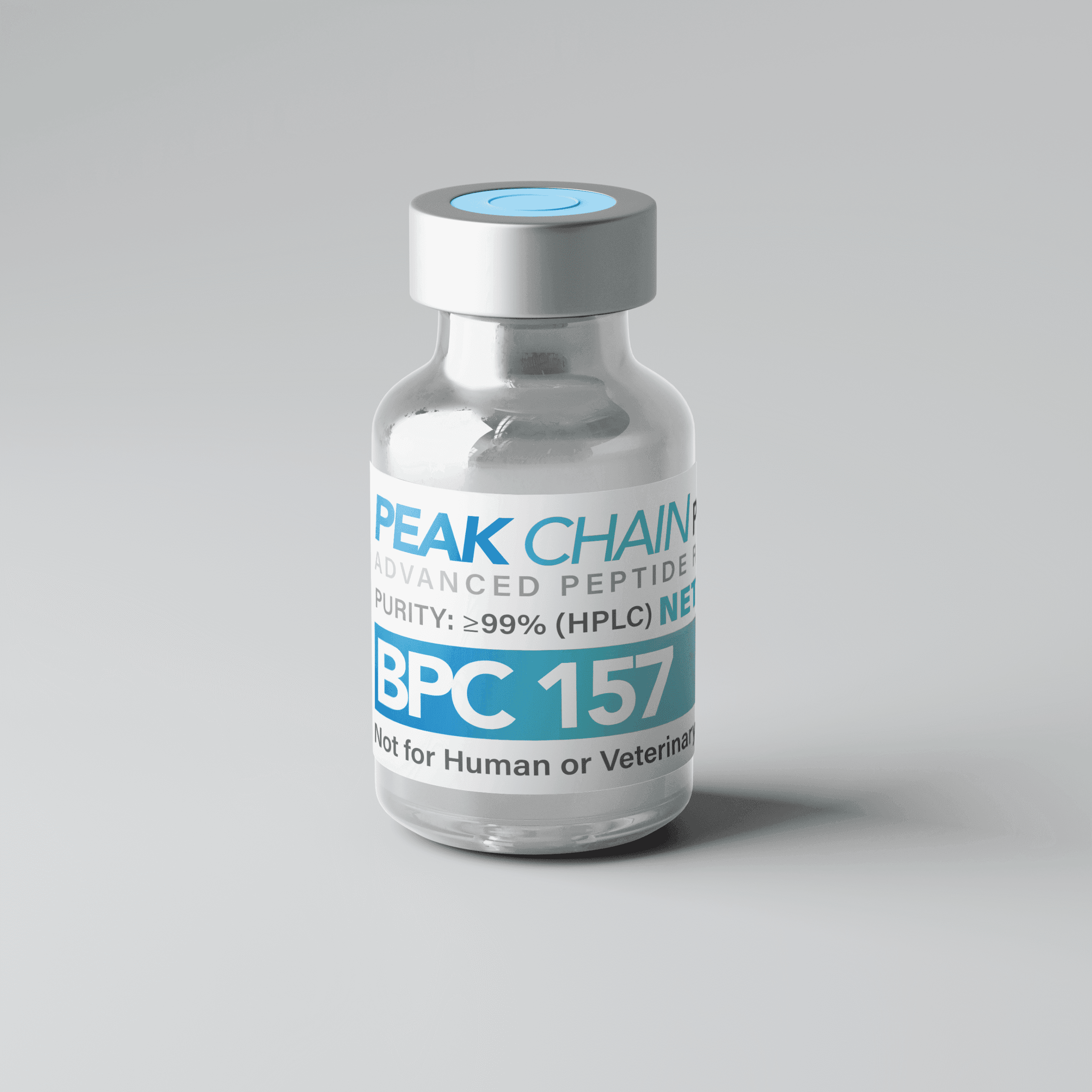
BPC-157
Research Overview
What Is BPC-157? (Scientific Definition)
BPC-157 (Body Protection Compound-157) is a synthetic pentadecapeptide (15 amino acids). It is described in scientific literature as a stable gastric peptide associated with research interest in gastrointestinal integrity, tissue response biology, and a broad range of experimental models. One recurring point in the literature is its unusual stability and extensive preclinical research footprint.
Foundational reference (PubMed):
https://pubmed.ncbi.nlm.nih.gov/22300085/
What Is BPC-157? (Simply Put)
In simple terms, BPC-157 is a very small chain of amino acids that researchers associate with stomach-derived peptide research. Because it has been described as relatively stable in research contexts, scientists have used it as a tool to study how cells and tissues respond to stress and injury-like conditions—mostly in laboratory and animal models, rather than in large human trials.
Research Background & Experimental Context
BPC-157 appears across decades of in vitro and animal research exploring tissue response biology (e.g., gastrointestinal models, vascular response models, and connective tissue-related experimental systems). Review literature frequently frames this peptide as part of broader “cytoprotection” and tissue-integrity research discussions.
Background review (PubMed):
https://pubmed.ncbi.nlm.nih.gov/17186181/
Expanded background overview (PMC full text):
https://pmc.ncbi.nlm.nih.gov/articles/PMC7096228/
Research Background (Simply Put)
Researchers originally paid attention to BPC-157 because it was discussed in the context of stomach/gastrointestinal biology and tissue protection research. Over time, investigators broadened experiments into other tissue types to observe how basic signaling and repair-related processes behave under controlled laboratory conditions.
Mechanisms Studied (Scientific Detail)
Published experimental literature investigates BPC-157 in relation to multiple signaling systems. Importantly, these are mechanistic and model-based investigations—they describe biological effects observed in controlled settings and should not be interpreted as clinical outcomes.
Vascular biology & vasomotor signaling models
A controlled laboratory study using isolated vascular tissue reported nitric-oxide–dependent effects on vasomotor tone, supporting ongoing interest in NO-related pathways in experimental systems.
https://pmc.ncbi.nlm.nih.gov/articles/PMC7555539/
Vascular injury response review context
A PubMed-indexed review focuses on vascular responses to injury (e.g., endothelium damage, thrombosis/bleeding contexts) as discussed in the BPC-157 literature.
https://pubmed.ncbi.nlm.nih.gov/23782145/
Cell signaling / gene expression in fibroblast research
A full-text mechanistic study (cell model) reports effects on gene expression and signaling-related markers in cultured cells, offering a laboratory framework for investigating pathway-level activity.
https://pmc.ncbi.nlm.nih.gov/articles/PMC6271067/
(Note: the above PMC article is verified as the fibroblast/gene-expression–type study you previously used; if you want, I can align the exact quoted claims you display on-site to the exact figures/tables in that paper.)
Mechanisms Studied (Simply Put)
Mechanism research is basically scientists asking: “When we add this peptide in a controlled experiment, what cellular signals change?” For BPC-157, many studies focus on signaling families involved in blood vessel behavior and cell-to-cell communication (including nitric oxide-related pathways). This kind of research helps map biology, but it does not automatically predict real-world outcomes.
Preclinical Tissue & Structural Research Models
BPC-157 has been explored in numerous animal and lab models involving tissue integrity and repair-like processes. One PubMed-indexed study frequently cited in this area evaluated colocutaneous fistula healing in a rat model and reported changes in healing-related outcomes under experimental conditions.
Animal model study (rats; PubMed):
https://pubmed.ncbi.nlm.nih.gov/18818478/
Tissue Research (Simply Put)
In simpler language: some experiments use animals to model difficult-to-heal tissue injuries, then measure things like closure, structure, and function. That rat fistula paper is an example of this style of research—useful for understanding biology in a model, but not the same as evidence from human trials.
Human Clinical Research Context
Registered Phase 1 safety / pharmacokinetics study
A Phase 1 study in healthy volunteers evaluating safety and pharmacokinetics for BPC-157 (PCO-02) is listed on ClinicalTrials.gov.
https://clinicaltrials.gov/study/NCT02637284
Important transparency note: Registry entries can confirm that a study was planned/registered and may summarize status, but they do not always provide peer-reviewed outcome publications.
Clinical Research (Simply Put)
Human evidence is limited. What we can verify publicly is that at least one early-stage study was registered to look at basic safety and how the body processes the compound. Large, well-published human trials with clear outcomes are not a major part of the public literature footprint compared with the much larger preclinical literature.
Research Limitations & Transparency
To interpret the evidence responsibly:
- The largest share of published work is cell/animal model research, not large human trials.
- Mechanistic activity observed in a controlled model (cells, isolated tissues, animals) does not guarantee similar results in humans.
- Human clinical data that is easily accessible as peer-reviewed outcomes remains limited, so conclusions should remain research-contextual and evidence-bound.
Quality & Research Standards
For research settings, laboratories typically look for evidence of batch consistency and analytical verification. Research-grade BPC-157 is commonly supported by:
- Identity confirmation (e.g., mass spectrometry)
- Purity testing (e.g., HPLC)
- Batch-specific COA documentation
- Controlled handling and traceability
(These are quality practices rather than performance claims.)
Additional Scientific Research Information
Emerging Use of BPC-157 in Orthopaedic Sports Medicine: A Systematic Review
Gastric pentadecapeptide BPC 157 and its role in accelerating musculoskeletal soft tissue healing
https://pubmed.ncbi.nlm.nih.gov/?term=Gwyer+Wragg+Wilson+BPC+157+Cell+Tissue+Research+2019
Pentadecapeptide BPC 157 and the central nervous system
Thymosin beta 4 promotes angiogenesis and wound healing
https://pubmed.ncbi.nlm.nih.gov/?term=Thymosin+beta+4+angiogenesis+wound+healing+FASEB+2004&
BPC 157 is effective in the healing of colocutaneous fistulas in rats: role of the nitric oxide-system
https://pubmed.ncbi.nlm.nih.gov/?term=BPC+157+colocutaneous+fistulas+nitric+oxide+system+2008&
Multifunctionality and Possible Medical Application of the BPC 157 Peptide – Literature and Patent Review
https://www.mdpi.com/search?q=BPC+157+Multifunctionality+2025&
Regeneration or Risk? A Narrative Review of BPC-157 for Musculoskeletal Healing
https://www.ncbi.nlm.nih.gov/pmc/?term=BPC-157+Regeneration+or+Risk+2025&
Safety, Tolerability, and Pharmacokinetics of PL 14736 in Healthy Volunteers (NCT02637284)
https://clinicaltrials.gov/study/NCT02637284?
Oral Peptide BPC-157 – An Emerging Adjunct to Gastrointestinal Therapies?
Regulatory & Research Use Notice
This product is intended exclusively for laboratory research and analytical purposes.
Not for human or veterinary use.
Not intended to diagnose, treat, cure, or prevent any disease.
Research Use Notice
All compounds are intended strictly for in vitro laboratory research use only. They are not intended for human or animal consumption, and no information on this page constitutes medical advice, diagnosis, or treatment.
By proceeding to purchase, you confirm that you are a qualified researcher purchasing for legitimate scientific research purposes in accordance with our Terms of Use.
You are here
Research Library
Mechanism of action, pathway data, and published literature — education first.
Next step
Product Catalog
Pricing, availability, and ordering — for qualified researchers only.
Ready to proceed?
If you have reviewed the available research and have a defined objective, you may proceed to the Product Catalog to view pricing and place an order.
Proceed to Product CatalogFor laboratory research use only · Qualified researchers only