
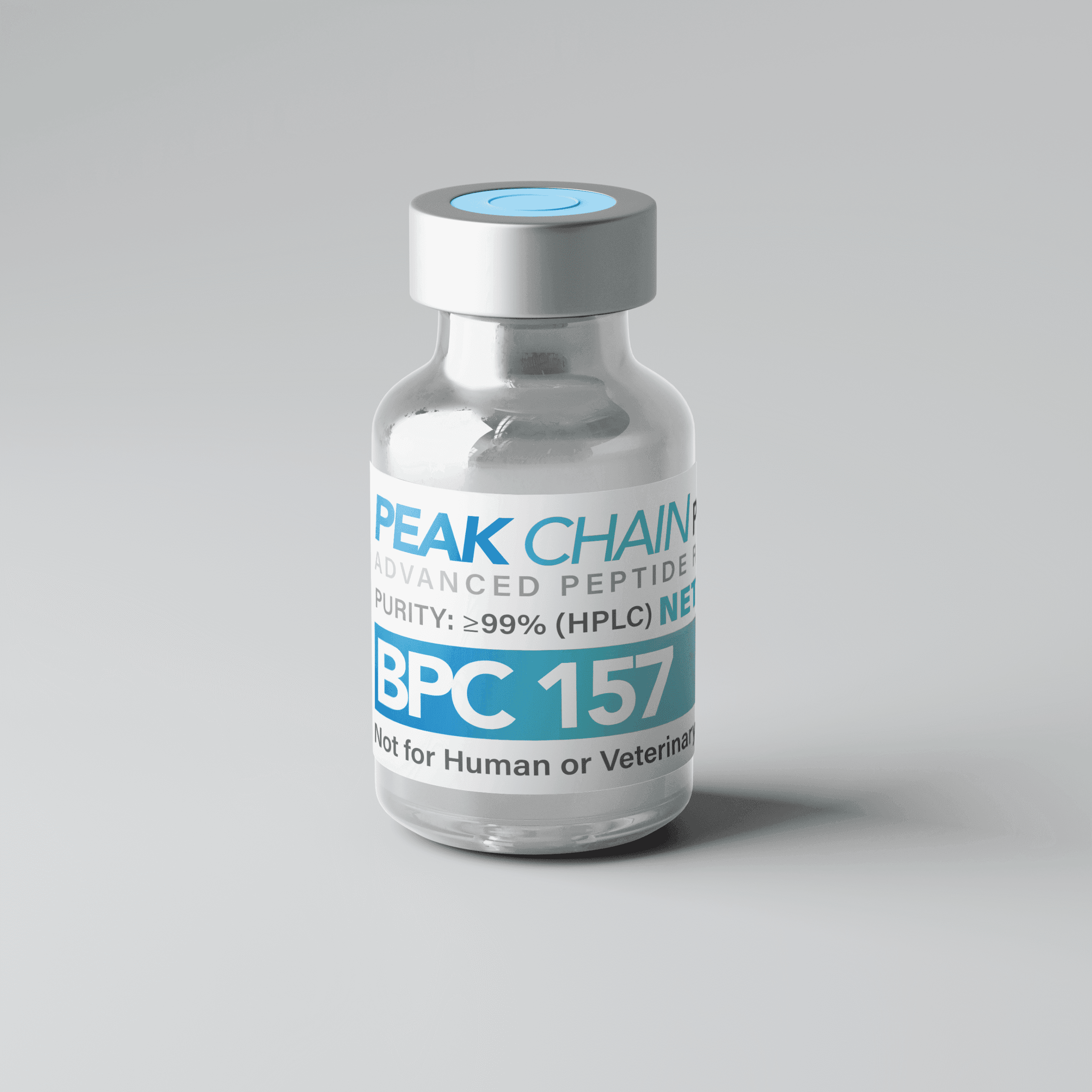
BPC-157
SKU: BC10-PC
What Is BPC-157? (Scientific Definition)
BPC-157 (Body Protection Compound-157) is a synthetic pentadecapeptide (15 amino acids). It is described in scientific literature as a stable gastric peptide associated with research interest in gastrointestinal integrity, tissue response biology, and a broad range of experimental models. One recurring point in the literature is its unusual stability and extensive preclinical research footprint.
Foundational reference (PubMed):
https://pubmed.ncbi.nlm.nih.gov/22300085/
What Is BPC-157? (Simply Put)
In simple terms, BPC-157 is a very small chain of amino acids that researchers associate with stomach-derived peptide research. Because it has been described as relatively stable in research contexts, scientists have used it as a tool to study how cells and tissues respond to stress and injury-like conditions—mostly in laboratory and animal models, rather than in large human trials.
Research Background & Experimental Context
BPC-157 appears across decades of in vitro and animal research exploring tissue response biology (e.g., gastrointestinal models, vascular response models, and connective tissue-related experimental systems). Review literature frequently frames this peptide as part of broader “cytoprotection” and tissue-integrity research discussions.
Background review (PubMed):
https://pubmed.ncbi.nlm.nih.gov/17186181/
Expanded background overview (PMC full text):
https://pmc.ncbi.nlm.nih.gov/articles/PMC7096228/
Research Background (Simply Put)
Researchers originally paid attention to BPC-157 because it was discussed in the context of stomach/gastrointestinal biology and tissue protection research. Over time, investigators broadened experiments into other tissue types to observe how basic signaling and repair-related processes behave under controlled laboratory conditions.
Mechanisms Studied (Scientific Detail)
Published experimental literature investigates BPC-157 in relation to multiple signaling systems. Importantly, these are mechanistic and model-based investigations—they describe biological effects observed in controlled settings and should not be interpreted as clinical outcomes.
Vascular biology & vasomotor signaling models
A controlled laboratory study using isolated vascular tissue reported nitric-oxide–dependent effects on vasomotor tone, supporting ongoing interest in NO-related pathways in experimental systems.
https://pmc.ncbi.nlm.nih.gov/articles/PMC7555539/
Vascular injury response review context
A PubMed-indexed review focuses on vascular responses to injury (e.g., endothelium damage, thrombosis/bleeding contexts) as discussed in the BPC-157 literature.
https://pubmed.ncbi.nlm.nih.gov/23782145/
Cell signaling / gene expression in fibroblast research
A full-text mechanistic study (cell model) reports effects on gene expression and signaling-related markers in cultured cells, offering a laboratory framework for investigating pathway-level activity.
https://pmc.ncbi.nlm.nih.gov/articles/PMC6271067/
(Note: the above PMC article is verified as the fibroblast/gene-expression–type study you previously used; if you want, I can align the exact quoted claims you display on-site to the exact figures/tables in that paper.)
Mechanisms Studied (Simply Put)
Mechanism research is basically scientists asking: “When we add this peptide in a controlled experiment, what cellular signals change?” For BPC-157, many studies focus on signaling families involved in blood vessel behavior and cell-to-cell communication (including nitric oxide-related pathways). This kind of research helps map biology, but it does not automatically predict real-world outcomes.
Preclinical Tissue & Structural Research Models
BPC-157 has been explored in numerous animal and lab models involving tissue integrity and repair-like processes. One PubMed-indexed study frequently cited in this area evaluated colocutaneous fistula healing in a rat model and reported changes in healing-related outcomes under experimental conditions.
Animal model study (rats; PubMed):
https://pubmed.ncbi.nlm.nih.gov/18818478/
Tissue Research (Simply Put)
In simpler language: some experiments use animals to model difficult-to-heal tissue injuries, then measure things like closure, structure, and function. That rat fistula paper is an example of this style of research—useful for understanding biology in a model, but not the same as evidence from human trials.
Human Clinical Research Context
Registered Phase 1 safety / pharmacokinetics study
A Phase 1 study in healthy volunteers evaluating safety and pharmacokinetics for BPC-157 (PCO-02) is listed on ClinicalTrials.gov.
https://clinicaltrials.gov/study/NCT02637284
Important transparency note: Registry entries can confirm that a study was planned/registered and may summarize status, but they do not always provide peer-reviewed outcome publications.
Clinical Research (Simply Put)
Human evidence is limited. What we can verify publicly is that at least one early-stage study was registered to look at basic safety and how the body processes the compound. Large, well-published human trials with clear outcomes are not a major part of the public literature footprint compared with the much larger preclinical literature.
Research Limitations & Transparency
To interpret the evidence responsibly:
- The largest share of published work is cell/animal model research, not large human trials.
- Mechanistic activity observed in a controlled model (cells, isolated tissues, animals) does not guarantee similar results in humans.
- Human clinical data that is easily accessible as peer-reviewed outcomes remains limited, so conclusions should remain research-contextual and evidence-bound.
Quality & Research Standards
For research settings, laboratories typically look for evidence of batch consistency and analytical verification. Research-grade BPC-157 is commonly supported by:
- Identity confirmation (e.g., mass spectrometry)
- Purity testing (e.g., HPLC)
- Batch-specific COA documentation
- Controlled handling and traceability
(These are quality practices rather than performance claims.)
Additional Scientific Research Information
Emerging Use of BPC-157 in Orthopaedic Sports Medicine: A Systematic Review
Gastric pentadecapeptide BPC 157 and its role in accelerating musculoskeletal soft tissue healing
https://pubmed.ncbi.nlm.nih.gov/?term=Gwyer+Wragg+Wilson+BPC+157+Cell+Tissue+Research+2019
Pentadecapeptide BPC 157 and the central nervous system
Thymosin beta 4 promotes angiogenesis and wound healing
https://pubmed.ncbi.nlm.nih.gov/?term=Thymosin+beta+4+angiogenesis+wound+healing+FASEB+2004&
BPC 157 is effective in the healing of colocutaneous fistulas in rats: role of the nitric oxide-system
https://pubmed.ncbi.nlm.nih.gov/?term=BPC+157+colocutaneous+fistulas+nitric+oxide+system+2008&
Multifunctionality and Possible Medical Application of the BPC 157 Peptide – Literature and Patent Review
https://www.mdpi.com/search?q=BPC+157+Multifunctionality+2025&
Regeneration or Risk? A Narrative Review of BPC-157 for Musculoskeletal Healing
https://www.ncbi.nlm.nih.gov/pmc/?term=BPC-157+Regeneration+or+Risk+2025&
Safety, Tolerability, and Pharmacokinetics of PL 14736 in Healthy Volunteers (NCT02637284)
https://clinicaltrials.gov/study/NCT02637284?
Oral Peptide BPC-157 – An Emerging Adjunct to Gastrointestinal Therapies?
Regulatory & Research Use Notice
This product is intended exclusively for laboratory research and analytical purposes.
Not for human or veterinary use.
Not intended to diagnose, treat, cure, or prevent any disease.
| SKU | BC10-PC |
|---|
Certificate of Analysis
Independent third-party analytical testing is performed on every production batch. The document to the left contains all testing results for the batch corresponding to this product.
Opens / saves as PDF document