
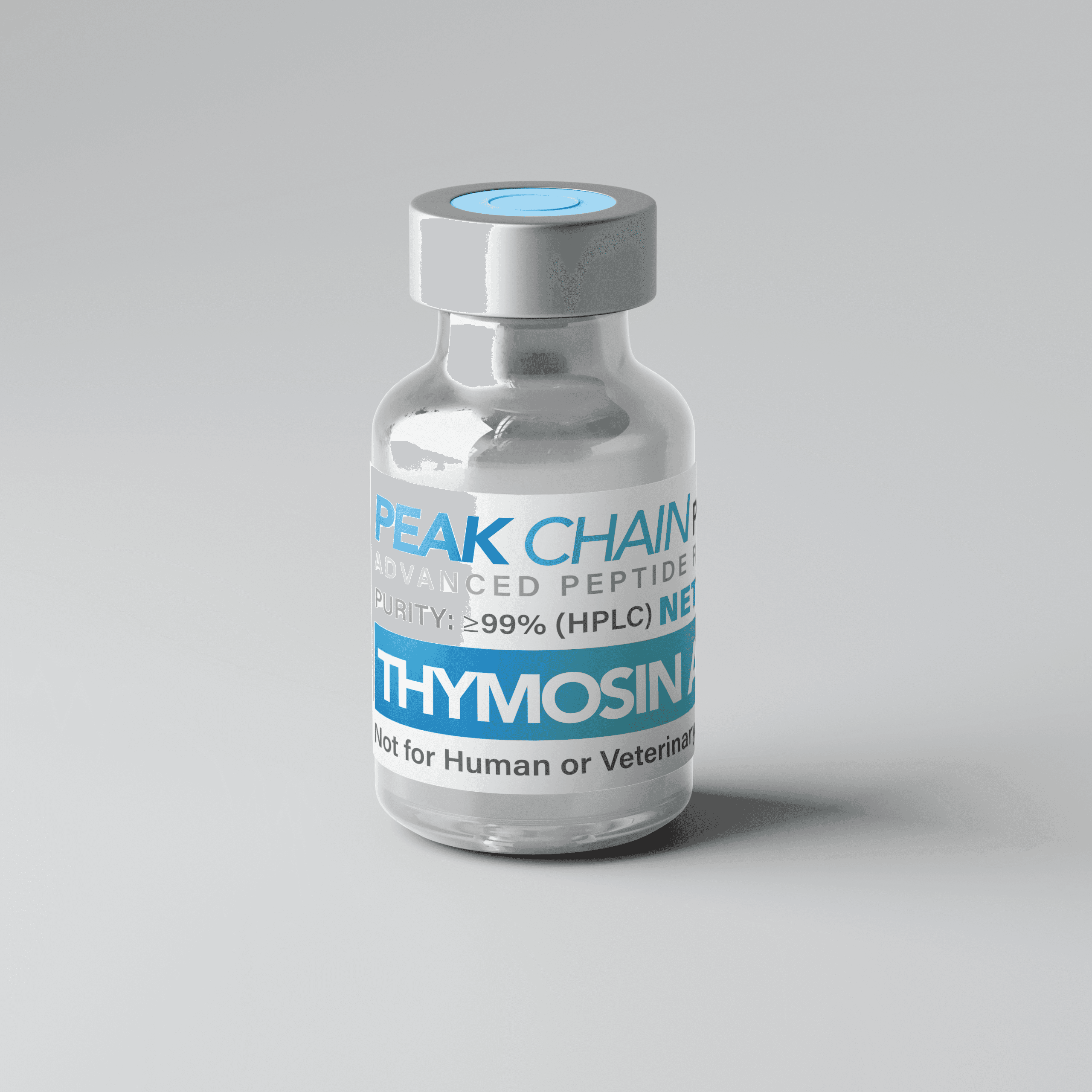
Thymosin Alpha 1
Research Overview
What Is Thymosin Alpha 1?
Thymosin Alpha 1 (Tα1) is a naturally occurring 28–amino-acid peptide originally isolated from thymic tissue and later produced synthetically as thymalfasin. In the scientific literature, Tα1 is classified as an immunomodulatory peptide, meaning it influences immune signaling and immune cell coordination rather than acting as a direct antimicrobial or antiviral agent.
Published reviews describe its role as supporting immune system organization, communication, and responsiveness across both innate and adaptive immune pathways (PMC).
Simply Put (Plain-English Explanation)
In simple terms, Thymosin Alpha 1 acts like an immune system trainer. Instead of attacking pathogens itself, it helps immune cells recognize signals, communicate more effectively, and respond in a more balanced way.
Researchers have studied Tα1 in situations where the immune system appears dysregulated or suppressed, such as chronic viral infections, critical illness, and immune recovery following cancer treatments (PMC).
Mechanisms of Action (How It Works Biologically)
Toll-Like Receptor (TLR) Signaling
Research demonstrates that Tα1 can interact with Toll-like receptors, particularly TLR2 and TLR9, which are key sensors used by immune cells to detect danger signals. Activation of these pathways has been shown to influence downstream immune signaling cascades involved in antiviral and antimicrobial responses (PMC; PubMed).
Dendritic Cell Activation and Antigen Presentation
Multiple studies report that Tα1 promotes the maturation and functional activation of dendritic cells, which are responsible for presenting antigens to T cells and shaping immune responses. This enhanced antigen presentation has been linked to improved coordination between innate and adaptive immunity (Blood Journal; PMC).
Adaptive Immune Modulation (Th1-Skewing)
Experimental models describe Tα1 as favoring Th1-type immune responses, which are associated with interferon signaling and cellular immunity. This effect has been observed in both infectious disease and oncology-related research settings (Blood Journal; PMC).
Published Human Medical Data (Summary of Clinical Research)
Chronic Hepatitis B (HBV)
Thymosin Alpha 1 has been evaluated in multiple human studies for chronic hepatitis B. A landmark multicenter, randomized, double-blind, placebo-controlled trial published in Hepatology investigated Tα1 in patients with chronic HBV infection, assessing virologic and biochemical outcomes (PubMed).
Additional comparative studies have examined Tα1 relative to interferon-based therapies, with variable outcomes depending on study design and patient population (PubMed).
Sepsis and Critical Illness
Tα1 has been studied in critically ill patients with sepsis, based on hypotheses related to immune exhaustion and dysregulation. A large randomized controlled trial (TESTS trial) reported no statistically significant reduction in 28-day all-cause mortality, highlighting the complexity of immune-targeted interventions in sepsis (PubMed).
Recent systematic reviews continue to explore subgroup responses and heterogeneity across studies, emphasizing cautious interpretation of earlier positive findings (PubMed; International Journal of Infectious Diseases).
COVID-19 (Investigational Research)
During the COVID-19 pandemic, thymalfasin was investigated in several clinical and observational studies. ClinicalTrials.gov lists interventional trials evaluating Tα1 as an immune-modulating adjunct in hospitalized patients (ClinicalTrials.gov – NCT04487444).
Published pilot and open-label studies explored immune markers such as lymphocyte recovery and inflammatory signaling, with findings described as preliminary and hypothesis-generating (PMC; PMC).
Oncology and Immune Recovery Research
Earlier oncology-related studies investigated Tα1 in the context of immune reconstitution following radiotherapy or chemotherapy. Randomized trials in non-small cell lung cancer assessed immune cell recovery and adjunctive effects when Tα1 was combined with conventional therapies (PubMed; PubMed).
Additional studies have explored its use in hepatocellular carcinoma as an immune-supportive adjunct following surgical or locoregional interventions (PubMed).
Safety Profile (Reported in Literature)
Across clinical trials and reviews, Thymosin Alpha 1 is generally described as well tolerated, with reported adverse effects typically mild and transient, such as localized reactions in injectable formulations. Safety outcomes vary depending on patient population, disease state, and co-administered therapies (PMC).
Regulatory and Compliance Context
Published reviews note that thymalfasin has been approved in more than 35 countries for immune-related indications, including viral hepatitis, outside the United States (PMC).
In the U.S., the FDA has stated that no drug products containing Thymosin Alpha 1 are currently approved, and the agency has issued enforcement actions against companies making unapproved disease treatment claims involving Tα1 (FDA Warning Letter; FDA Bulk Substance Review).
Potential Researcher Benefits (Research-Use Framing)
From a laboratory and academic research perspective, Thymosin Alpha 1 continues to be explored for:
- Innate immune signaling research, including Toll-like receptor activation and downstream cytokine pathways (PMC).
- Adaptive immune coordination studies, focusing on dendritic cell–T cell interactions and immune restoration models (Blood Journal).
- Combination and adjunctive research, where Tα1 is evaluated alongside antivirals, oncology therapies, or supportive care interventions (PubMed).
- Biomarker-driven investigations, including lymphocyte counts, interferon signaling, and immune exhaustion markers (PMC).
Research-Only Website Compliance Statement
This information is provided for scientific and educational purposes only. Thymosin Alpha 1 products are intended for research use only and are not intended to diagnose, treat, cure, or prevent any disease.
Research Use Notice
All compounds are intended strictly for in vitro laboratory research use only. They are not intended for human or animal consumption, and no information on this page constitutes medical advice, diagnosis, or treatment.
By proceeding to purchase, you confirm that you are a qualified researcher purchasing for legitimate scientific research purposes in accordance with our Terms of Use.
You are here
Research Library
Mechanism of action, pathway data, and published literature — education first.
Next step
Product Catalog
Pricing, availability, and ordering — for qualified researchers only.
Ready to proceed?
If you have reviewed the available research and have a defined objective, you may proceed to the Product Catalog to view pricing and place an order.
Proceed to Product CatalogFor laboratory research use only · Qualified researchers only