
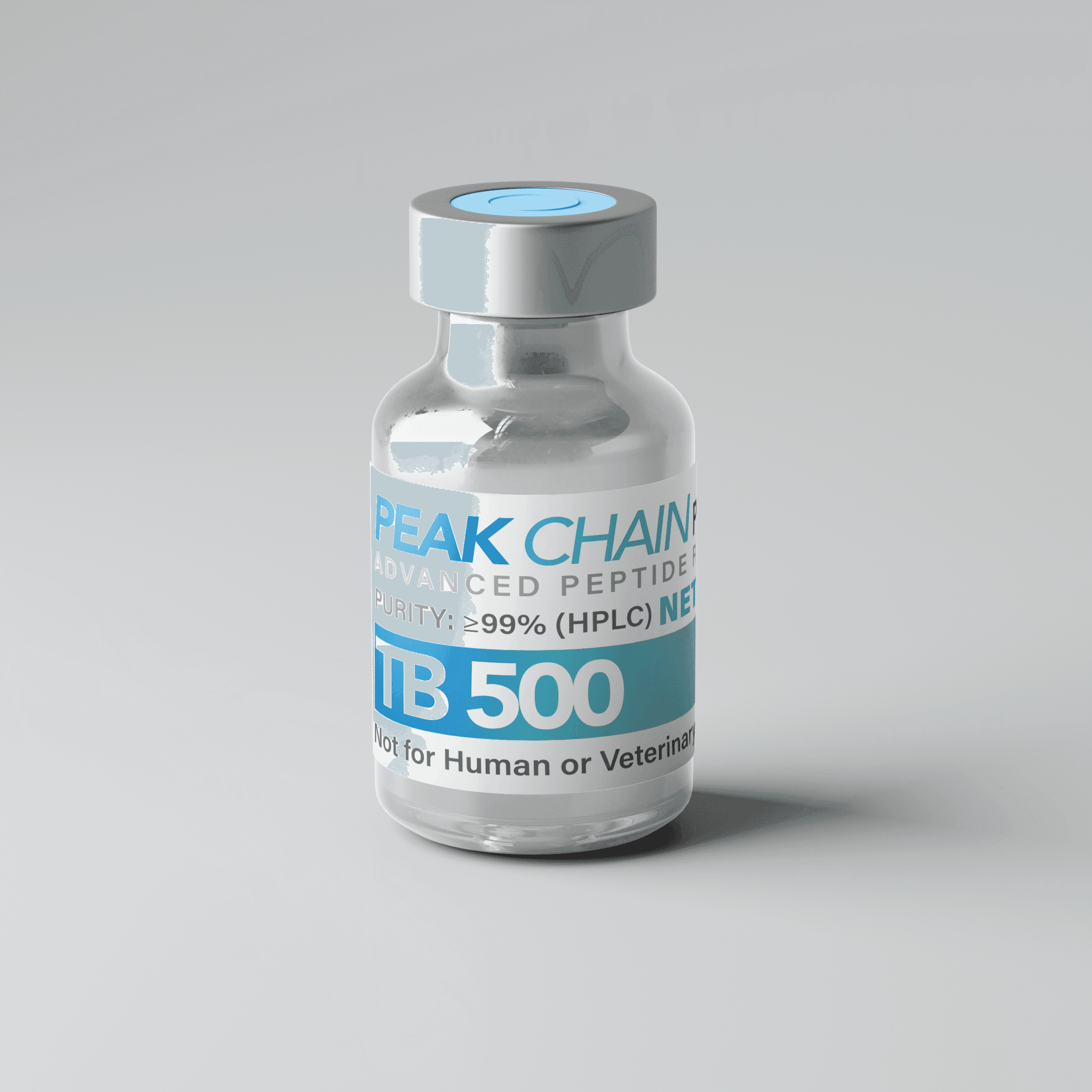
TB-500
Research Overview
What Is TB-500?
TB-500 is a research-designated peptide associated with thymosin beta-4 (Tβ4), a naturally occurring 43–amino acid peptide found in nearly all human and animal tissues. Thymosin beta-4 was originally identified as a cellular protein involved in actin regulation — the internal structural network that allows cells to move, divide, and maintain shape.
In research settings, TB-500 typically refers to a synthetic form or fragment derived from thymosin beta-4 and is studied for its involvement in:
- Cellular migration
- Cytoskeletal organization
- Inflammatory regulation
- Tissue remodeling
- Stem cell signaling
- Vascular repair biology
Most published medical and translational research references thymosin beta-4 itself, not commercial TB-500 formulations. The scientific discussion below reflects peer-reviewed literature examining Tβ4’s biological functions across multiple organ systems.
TB-500 products offered commercially are positioned strictly for laboratory research purposes.
Biological Discovery & Foundational Mechanisms
https://pubmed.ncbi.nlm.nih.gov/34495765/
This foundational review details the molecular characterization of thymosin beta-4, including its discovery, structure, and interaction with actin monomers. It explains how Tβ4 regulates the cellular cytoskeleton and coordinates migration signaling pathways.
Simply Put:
Cells need an internal “skeleton” to move and repair tissue. Tβ4 helps organize that structure, allowing cells to travel to injured areas and participate in rebuilding.
Adult Organ Remodeling & Regenerative Aging Biology
https://pubmed.ncbi.nlm.nih.gov/34071596/
This publication examines thymosin beta-4’s role in adult organ systems and regenerative signaling. The research explores how Tβ4 participates in tissue maintenance, repair processes, and structural remodeling within aging environments.
The paper highlights how cytoskeletal regulation, migration pathways, and cellular stress responses intersect with regenerative biology research.
Simply Put:
As tissues age, their repair capacity slows. Scientists study Tβ4 to understand how it may help coordinate natural repair signals in adult organs.
Chronic Liver Stress & Non-Alcoholic Fatty Liver Disease (NAFLD)
https://pubmed.ncbi.nlm.nih.gov/29063072/
This publication discusses thymosin beta-4 in chronic inflammatory disease contexts, including metabolic and hepatic stress models such as non-alcoholic fatty liver disease. The research focuses on inflammatory signaling balance and tissue remodeling mechanisms.
Simply Put:
NAFLD involves inflammation and stress in liver tissue. Researchers examine Tβ4 to better understand how it interacts with inflammatory pathways during chronic tissue stress.
Liver Fibrosis & Extracellular Matrix Remodeling
https://pubmed.ncbi.nlm.nih.gov/26006229/
This publication reviews thymosin beta-4’s role in extracellular matrix regulation and fibrotic signaling pathways. The research discusses how Tβ4 influences collagen deposition, tissue remodeling, and inflammatory responses within fibrotic liver environments.
Simply Put:
Fibrosis happens when scar-like tissue builds up in organs like the liver. Scientists study Tβ4 to understand how it may influence scar formation and tissue remodeling processes.
Emerging Regenerative & Longevity Research Directions
https://pubmed.ncbi.nlm.nih.gov/36709593/
This recent publication explores thymosin beta-4 within immune-regenerative signaling networks. It highlights expanding interest in Tβ4’s role in coordinating inflammatory resolution and cellular recovery pathways.
The research reflects broader scientific exploration into regenerative medicine and age-associated tissue maintenance biology.
Simply Put:
Newer research looks at how Tβ4 fits into the body’s overall repair and recovery systems, especially as scientists study longevity and regenerative processes.
Endothelial Function & Vascular Repair
https://pubmed.ncbi.nlm.nih.gov/35012642/
This study investigates thymosin beta-4 in stem cell–associated repair microenvironments and endothelial signaling systems. Endothelial cells line blood vessels and are essential for vascular stability and tissue oxygen delivery.
The research explores how Tβ4 influences vascular remodeling and regenerative signaling cascades.
Simply Put:
Healthy blood vessels are critical for tissue repair. Scientists study whether Tβ4 helps support the cells that maintain and repair blood vessels.
Sepsis & Systemic Inflammatory Response
https://pubmed.ncbi.nlm.nih.gov/29508629/
This publication evaluates thymosin beta-4 within severe inflammatory environments and systemic immune responses, including conditions such as sepsis. It examines Tβ4’s regulatory role in cytokine signaling and inflammatory cascade modulation.
The research contributes to understanding how Tβ4 interacts with complex immune responses during systemic stress.
Simply Put:
Sepsis involves overwhelming inflammation throughout the body. Researchers investigate whether Tβ4 helps regulate or balance inflammatory responses in experimental models.
Alzheimer’s Disease & Neurodegenerative Intervention Research
https://pubmed.ncbi.nlm.nih.gov/40816274/
This publication explores thymosin beta-4 in neural regenerative microenvironments and progenitor cell signaling relevant to neurodegenerative conditions, including Alzheimer’s disease models.
The research evaluates how Tβ4 participates in cellular survival pathways and neural tissue remodeling in laboratory settings.
Simply Put:
Alzheimer’s disease affects brain cells. Scientists study Tβ4 to see how it interacts with brain repair mechanisms and cellular survival pathways in experimental systems.
Protection of Hippocampal Neuronal Cells
https://pubmed.ncbi.nlm.nih.gov/37175330/
This publication reviews molecular mechanisms through which thymosin beta-4 influences neuronal survival signaling and cellular stress resistance, including pathways relevant to hippocampal neurons.
The hippocampus is a brain region central to memory and learning, making it a focus of regenerative neuroscience research.
Simply Put:
The hippocampus plays a major role in memory. Research suggests Tβ4 may influence pathways that help protect brain cells from stress in laboratory studies.
Integrated Summary of TB-500 / Tβ4 Research Domains
The scientific literature supports ongoing research into thymosin beta-4 across multiple biological systems, including:
- Cytoskeletal organization
- Tissue remodeling
- Adult organ maintenance
- Chronic inflammatory disease models
- Vascular and endothelial biology
- Systemic immune regulation
- Neurodegenerative research
- Stem cell–associated regenerative pathways
Most findings remain within laboratory, preclinical, and translational research contexts.
Compliance Statement
The references provided above are for educational and independent scientific review purposes only.
TB-500 products are offered strictly for laboratory research use.
Not for human consumption.
Not approved to diagnose, treat, cure, or prevent disease.
Research Use Notice
All compounds are intended strictly for in vitro laboratory research use only. They are not intended for human or animal consumption, and no information on this page constitutes medical advice, diagnosis, or treatment.
By proceeding to purchase, you confirm that you are a qualified researcher purchasing for legitimate scientific research purposes in accordance with our Terms of Use.
You are here
Research Library
Mechanism of action, pathway data, and published literature — education first.
Next step
Product Catalog
Pricing, availability, and ordering — for qualified researchers only.
Ready to proceed?
If you have reviewed the available research and have a defined objective, you may proceed to the Product Catalog to view pricing and place an order.
Proceed to Product CatalogFor laboratory research use only · Qualified researchers only