
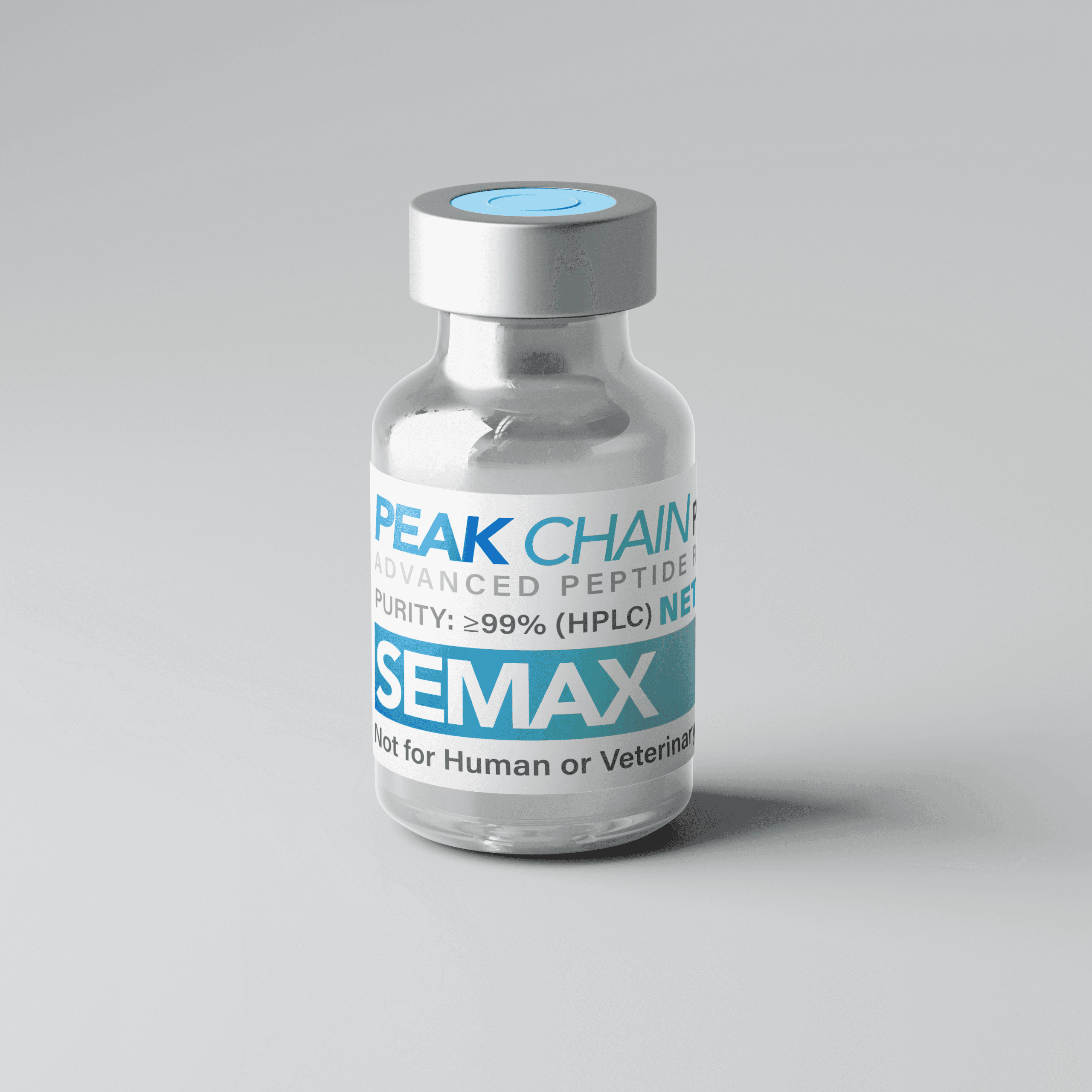
Semax
Research Overview
What Is Semax?
Semax is a synthetic regulatory neuropeptide derived from a fragment of adrenocorticotropic hormone (ACTH 4-10), modified with a Pro-Gly-Pro sequence to enhance enzymatic stability and biological persistence.
It was developed at the Institute of Molecular Genetics of the Russian Academy of Sciences and has been studied for over two decades in both experimental neuroscience and clinical neurology settings.
Unlike full-length ACTH, Semax does not exert significant adrenal corticosteroid effects. Instead, it appears to function primarily as a neuroregulatory peptide, influencing gene expression, neurotrophic signaling, and inflammatory cascades within the central nervous system.
Structural and developmental background review:
https://pmc.ncbi.nlm.nih.gov/articles/PMC12755871/
Mechanistic pharmacology overview:
https://pubmed.ncbi.nlm.nih.gov/16635254/
Regulatory Status:
Semax is not FDA-approved in the United States. It has been used clinically in Russia and is included in Russian essential medicine listings. All discussion below is educational and research-focused.
What Makes Semax Mechanistically Distinct?
Semax is frequently described in the literature as a regulatory neuropeptide rather than a classical receptor agonist stimulant.
Definition: Regulatory Neuropeptide
A short peptide that modulates intracellular signaling and gene transcription rather than directly activating or blocking a single neurotransmitter system.
Simply Put:
Instead of “forcing” the brain to release dopamine or serotonin, Semax appears to influence internal repair, growth, and adaptation systems at the cellular level.
Mechanisms of Action
(Based on published preclinical and translational research)
1️⃣ Neurotrophic Signaling & Plasticity Modulation (BDNF / TrkB)
Semax has been shown in experimental ischemia and stress models to increase expression of genes related to:
- Brain-Derived Neurotrophic Factor (BDNF)
- TrkB receptor signaling
- Neurotrophin regulatory cascades
BDNF is a central regulator of synaptic plasticity, neuronal survival, and long-term potentiation.
Supporting experimental research:
https://pubmed.ncbi.nlm.nih.gov/16635254/
Gene transcription modulation following ischemic injury:
https://pmc.ncbi.nlm.nih.gov/articles/PMC11498467/
Definition: Neuroplasticity
The brain’s ability to reorganize, form new connections, and adapt after stress or injury.
Simply Put:
BDNF functions like a growth and repair signal for neurons. Research suggests Semax may help increase these repair signals in stressed brain tissue.
2️⃣ Anti-Inflammatory & Immune Gene Regulation in Ischemia
Genome-wide expression profiling in rodent models of focal cerebral ischemia demonstrates that Semax alters expression of:
- Cytokine-related genes
- Chemokine signaling molecules
- Immune activation pathways
- Vascular regulatory genes
This suggests Semax may act at the transcriptional level to shift inflammatory signaling programs following neural injury.
Comprehensive transcriptomic analysis:
https://pmc.ncbi.nlm.nih.gov/articles/PMC3987924/
Simply Put:
After brain injury, inflammation can either worsen damage or support recovery. Semax appears to influence how inflammatory genes behave in experimental models.
3️⃣ Neuroprotection in Experimental Stroke Models
In preclinical photothrombotic and focal ischemia models, Semax administration has been associated with:
- Reduced infarct volume
- Improved memory task performance
- Functional neurological preservation
Preclinical ischemia study:
https://pubmed.ncbi.nlm.nih.gov/17603664/
Simply Put:
In animal stroke models, Semax-treated subjects showed smaller areas of brain damage and better behavioral recovery.
4️⃣ Intranasal Delivery & CNS Distribution
Semax has been extensively studied using intranasal delivery models to evaluate transport into brain tissue.
Rodent pharmacokinetic research suggests measurable CNS distribution following intranasal administration.
Pharmacokinetic distribution study:
https://pubmed.ncbi.nlm.nih.gov/16523722/
Simply Put:
Research suggests Semax can reach brain tissue through the nasal route in animal models.
Human Clinical Research
(Primarily conducted in Russia and post-Soviet medical centers)
Acute Ischemic Stroke Studies
Clinical investigations report improved neurological scale outcomes in Semax-treated acute ischemic stroke patients compared to conventional therapy.
Clinical stroke study:
https://pubmed.ncbi.nlm.nih.gov/11517472/
Immunobiochemical mechanisms in stroke patients:
https://pubmed.ncbi.nlm.nih.gov/10358912/
Important context:
Much of this research originates from regional clinical systems and has not been widely replicated in large multicenter Western trials.
Simply Put:
Some clinical studies suggest Semax may support recovery after stroke, though broader international trials are limited.
Post-Stroke Rehabilitation & BDNF Elevation
A 2018 clinical investigation reported that Semax administration during rehabilitation was associated with increased plasma BDNF levels and improved functional recovery measures.
Study reference:
https://pubmed.ncbi.nlm.nih.gov/29798983/
Simply Put:
Patients receiving Semax during rehab showed increases in proteins associated with brain repair.
Cognitive & Attention Research
A human study examining nootropic-like activity reported improvements in attention and short-term memory under fatigue conditions.
Human cognition study:
https://onlinelibrary.wiley.com/doi/abs/10.1002/%28SICI%291520-6769%28199609%2919%3A2%3C115%3A%3AAID-NRC171%3E3.0.CO%3B2-B
Simply Put:
Some early research suggests Semax may support focus under mental stress.
Functional Brain Imaging (fMRI)
A placebo-controlled resting-state fMRI study demonstrated measurable differences in default mode network connectivity in participants receiving Semax.
fMRI research reference:
https://pubmed.ncbi.nlm.nih.gov/30225715/
Simply Put:
Brain scans show Semax may influence how certain brain networks communicate at rest.
Ophthalmologic & Optic Nerve Research
Clinical investigations have explored Semax in optic nerve disorders and glaucomatous neuropathy.
Optic nerve functional study:
https://pubmed.ncbi.nlm.nih.gov/10741256/
Glaucomatous optic neuropathy study:
https://pubmed.ncbi.nlm.nih.gov/11569188/
Simply Put:
Some studies suggest Semax may have protective effects on optic nerve function.
Exploratory Neurodegeneration Research
Preclinical work has explored Semax in amyloid-related oxidative stress models and transgenic Alzheimer’s mouse models.
Exploratory study reference:
https://pmc.ncbi.nlm.nih.gov/articles/PMC8855339/
Important clarification:
These findings are investigational and do not establish clinical benefit in neurodegenerative disease.
Safety & Tolerability Overview
Published summaries indicate Semax has been generally well tolerated in clinical settings where used, though:
- Large-scale Western RCT data are limited
- Long-term safety outside regional use is not extensively characterized
Independent scientific evidence review:
Potential Research Applications
Based on published data, Semax may be investigated in laboratory models involving:
- Neurotrophic signaling pathways (BDNF / TrkB modulation)
- Gene transcription and inflammatory cascade studies
- Cerebral ischemia and hypoxia models
- Intranasal CNS peptide delivery systems
- Optic nerve and retinal neuroprotection research
These applications remain investigational and research-based.
Additional Scientific Research on Semax
(Unique to this peptide — not duplicated above)
Comprehensive molecular mechanism review:
https://pmc.ncbi.nlm.nih.gov/articles/PMC12755871/
Neuropeptide pharmacology overview:
https://pubmed.ncbi.nlm.nih.gov/16635254/
Transcriptomic regulation following ischemia:
https://pmc.ncbi.nlm.nih.gov/articles/PMC11498467/
Gusev EI, et al. “The efficacy of semax in the treatment of patients at different stages of ischemic stroke.” Zh Nevrol Psikhiatr Im S S Korsakova, 2018
https://pubmed.ncbi.nlm.nih.gov/29798983/
Miasoedova NF, et al. “Investigation of mechanisms of neuro-protective effect of semax in acute period of ischemic stroke.” Zh Nevrol Psikhiatr Im S S Korsakova, 1997
https://pubmed.ncbi.nlm.nih.gov/10358912/
Medvedeva EV, et al. “The peptide semax affects the expression of genes related to the immune and vascular systems in rat brain focal ischemia: genome-wide transcriptional analysis.” BMC Genomics, 2014
https://www.ncbi.nlm.nih.gov/pmc/articles/PMC3987924/
Dergunova LV, et al. “Novel Insights into the Protective Properties of ACTH(4-7)PGP (Semax) Peptide at the Transcriptome Level Following Cerebral Ischaemia-Reperfusion in Rats.” Genes (MDPI), 2020
https://pubmed.ncbi.nlm.nih.gov/32580520/
Dolotov OV, et al. “Semax and Pro-Gly-Pro Activate the Transcription of Neurotrophins and Their Receptor Genes after Cerebral Ischemia.” Cellular and Molecular Neurobiology, 2010
https://pubmed.ncbi.nlm.nih.gov/19633950/
Bakhmet AA, et al. “Functional Connectomic Approach to Studying Selank and Semax Effects.” Bulletin of Experimental Biology and Medicine, 2020
https://pubmed.ncbi.nlm.nih.gov/32342318/
La Mendola D, et al. “Semax, a Synthetic Regulatory Peptide, Affects Copper-Induced Abeta Aggregation and Amyloid Formation in Artificial Membrane Models.” ACS Chemical Neuroscience, 2022
https://www.ncbi.nlm.nih.gov/pmc/articles/PMC8855339/
Kolomin T, et al. “A New Generation of Drugs: Synthetic Peptides Based on Natural Regulatory Peptides.” Neuroscience & Medicine, 2013
https://www.scirp.org/journal/paperinformation?paperid=40560
Wikipedia — Semax
https://en.wikipedia.org/wiki/Semax
Alzheimer’s Drug Discovery Foundation — Semax Cognitive Vitality For Researchers (PDF)
Compliance Statement
Semax is offered strictly for laboratory research and educational purposes only.
It is not approved by the U.S. Food and Drug Administration for diagnosis, treatment, cure, or prevention of any disease.
All referenced publications are provided for independent scientific review.
Research Use Notice
All compounds are intended strictly for in vitro laboratory research use only. They are not intended for human or animal consumption, and no information on this page constitutes medical advice, diagnosis, or treatment.
By proceeding to purchase, you confirm that you are a qualified researcher purchasing for legitimate scientific research purposes in accordance with our Terms of Use.
You are here
Research Library
Mechanism of action, pathway data, and published literature — education first.
Next step
Product Catalog
Pricing, availability, and ordering — for qualified researchers only.
Ready to proceed?
If you have reviewed the available research and have a defined objective, you may proceed to the Product Catalog to view pricing and place an order.
Proceed to Product CatalogFor laboratory research use only · Qualified researchers only