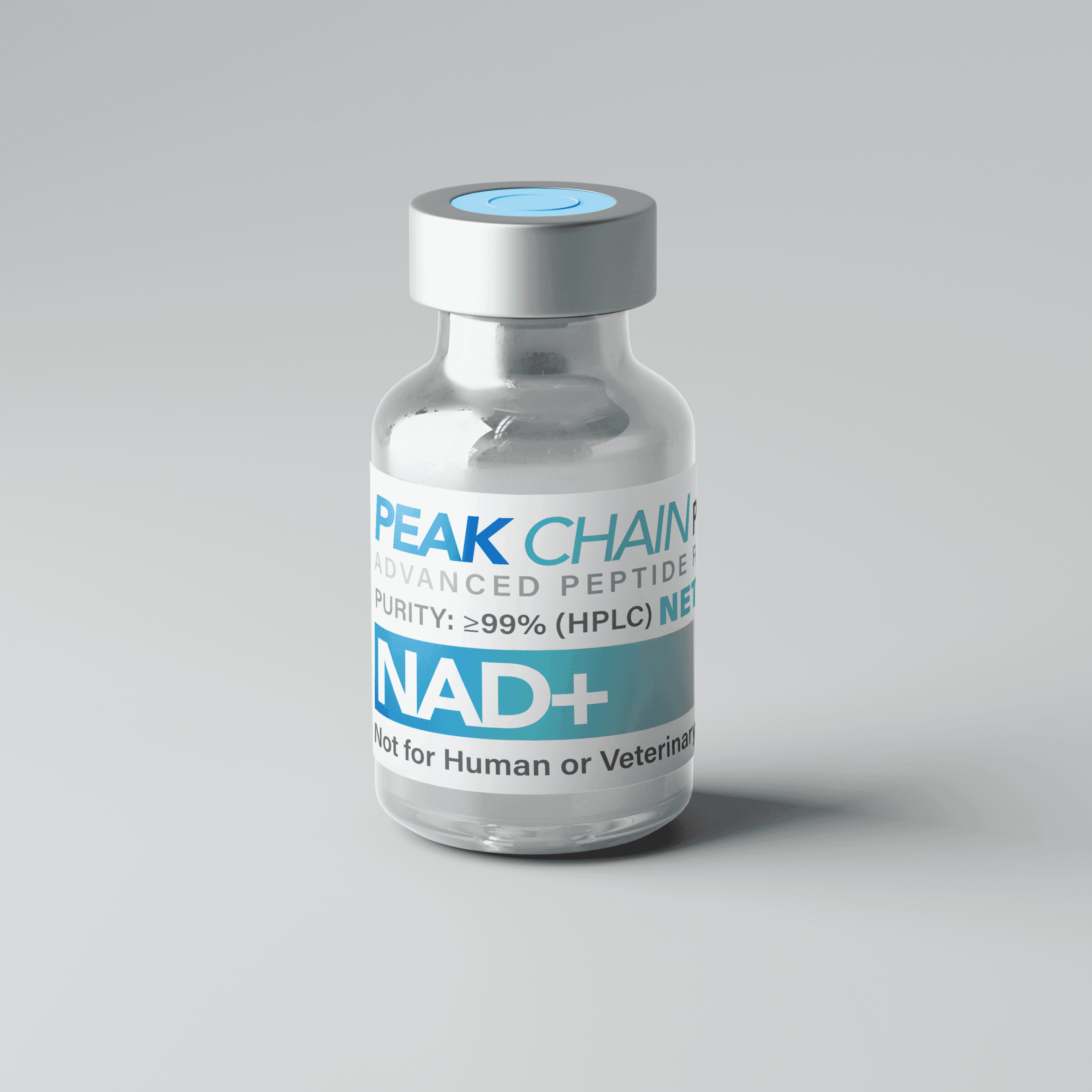
NAD+
Research Overview
What Is NAD⁺ (Nicotinamide Adenine Dinucleotide)?
NAD⁺ is a naturally occurring coenzyme found in all living cells and is essential for cellular energy metabolism, DNA repair, redox balance, and enzymatic regulation. It functions both as an electron carrier in metabolic reactions and as a required substrate for several regulatory enzymes involved in cellular maintenance and stress response.
A comprehensive overview of NAD⁺ metabolism and its role in cellular processes can be found in Covarrubias et al., 2020, which details how NAD⁺ supports mitochondrial function, DNA repair, and aging-associated pathways
https://pmc.ncbi.nlm.nih.gov/articles/PMC7963035/
Role in Cellular Energy Metabolism
NAD⁺ plays a central role in ATP production by acting as an electron acceptor during glycolysis, the tricarboxylic acid (TCA) cycle, and oxidative phosphorylation. Its availability directly influences mitochondrial efficiency and overall cellular energy balance.
The relationship between NAD⁺ metabolism and energy homeostasis is reviewed in Cantó & Auwerx, 2015, which describes how NAD⁺ regulates metabolic flux and mitochondrial signaling
https://pmc.ncbi.nlm.nih.gov/articles/PMC4487780/
Further mechanistic insight into how NAD⁺ availability affects mitochondrial and metabolic function is discussed in Xie et al., 2020
https://www.nature.com/articles/s41392-020-00311-7
DNA Repair and Genomic Stability
NAD⁺ is a required substrate for poly(ADP-ribose) polymerases (PARPs), enzymes that are activated in response to DNA strand breaks. When DNA damage occurs, PARPs consume NAD⁺ to coordinate DNA repair signaling and chromatin remodeling.
The relationship between PARP activity and NAD⁺ depletion is described in Hurtado-Bagès et al., 2020
https://pmc.ncbi.nlm.nih.gov/articles/PMC7300387/
Additional experimental evidence linking NAD⁺ availability to DNA repair efficiency is reported in Wilk et al., 2020
https://www.nature.com/articles/s41598-020-57506-9
Sirtuins and Regulatory Signaling
Sirtuins (SIRT1–SIRT7) are NAD⁺-dependent enzymes that regulate transcription, mitochondrial biogenesis, metabolic signaling, and cellular stress responses. NAD⁺ availability directly influences sirtuin activity, linking cellular energy status to gene regulation.
The foundational role of NAD⁺ in sirtuin-mediated regulation is reviewed in Imai & Guarente, 2014
https://pmc.ncbi.nlm.nih.gov/articles/PMC4112140/
A broader discussion of NAD⁺-sirtuin interactions and their relevance to aging biology is presented in Imai et al., 2016
https://www.nature.com/articles/npjamd201617
Age-Associated Decline of NAD⁺ (Research Context)
Multiple studies report that intracellular NAD⁺ levels decline with age, metabolic stress, inflammation, and oxidative damage. This decline has been associated with altered mitochondrial function, reduced DNA repair capacity, and changes in cellular resilience.
A clinical and translational overview of NAD⁺ decline and its biological implications is provided in Radenkovic et al., 2020
https://pmc.ncbi.nlm.nih.gov/articles/PMC7558103/
More recent discussions on NAD⁺ metabolism in aging can be found in Yusri et al., 2025
https://www.nature.com/articles/s44324-025-00067-0
NAD⁺ Precursors in Human Research
Most human studies investigating NAD⁺ biology do not administer NAD⁺ directly but instead evaluate NAD⁺ precursors (such as NMN or NR) to examine intracellular NAD⁺ dynamics and metabolic effects.
A review of human and preclinical research on NAD⁺-boosting compounds is available in Freeberg et al., 2023
https://pmc.ncbi.nlm.nih.gov/articles/PMC10692436/
An example of registered human research examining NAD⁺ levels can be found at ClinicalTrials.gov (NCT03707652)
https://clinicaltrials.gov/study/NCT03707652
Research Applications
In laboratory settings, NAD⁺ is widely used to study:
- Cellular energy metabolism
- Mitochondrial signaling
- DNA damage response pathways
- Aging and senescence biology
- Neurobiology and metabolic regulation
Because NAD⁺ sits at the intersection of energy production, repair mechanisms, and regulatory signaling, it is considered a foundational molecule in modern cellular and systems biology research.
Simply Put (Educational Only)
NAD⁺ is a molecule that helps cells turn food into energy and repair everyday damage. Scientists study it because cells rely on NAD⁺ to function efficiently, and levels naturally decrease as organisms age or experience stress. Ongoing research aims to better understand how NAD⁺ supports normal cellular processes and how changes in its levels affect cells over time.
Additional Scientific Research Information
Martens CR, Denman BA, Mazzo MR, et al. “Chronic nicotinamide riboside supplementation is well-tolerated and elevates NAD+ in healthy middle-aged and older adults.” Nature Communications, 2018.
https://doi.org/10.1038/s41467-018-03421-7
Conze D, Brenner C, Kruger CL. “Safety and Metabolism of Long-term Administration of NIAGEN (Nicotinamide Riboside Chloride) in Healthy Overweight Adults.” Scientific Reports, 2019.
https://doi.org/10.1038/s41598-019-46120-z
Yoshino M, Yoshino J, Kayser BD, et al. “Nicotinamide mononucleotide increases muscle insulin sensitivity in prediabetic women.” Science, 2021.
https://doi.org/10.1126/science.abe9985
Braidy N, Liu Y. “NAD+ therapy in age-related degenerative disorders: A benefit/risk analysis.” Experimental Gerontology, 2020.
https://doi.org/10.1016/j.exger.2020.110831
Elhassan YS, Kluckova K, Fletcher RS, et al. “Nicotinamide Riboside Augments the Aged Human Skeletal Muscle NAD+ Metabolome and Induces Transcriptomic and Anti-inflammatory Signatures.” Cell Reports, 2019.
https://pubmed.ncbi.nlm.nih.gov/31412242/
Brakedal B, Dolle C, Riber F, et al. “The NADPARK study: A randomized phase I trial of nicotinamide riboside supplementation in Parkinson’s disease.” Cell Metabolism, 2022.
https://pubmed.ncbi.nlm.nih.gov/35235774/
Dollerup OL, Christensen B, Svart M, et al. “A randomized placebo-controlled clinical trial of nicotinamide riboside in obese men.” American Journal of Clinical Nutrition, 2018.
https://pubmed.ncbi.nlm.nih.gov/29992272/
Campagnoli C, Yoo E, Liu Y, et al. “Clinical Evidence for Targeting NAD Therapeutically.” Pharmaceuticals, 2020.
https://doi.org/10.3390/ph13090247
Hong W, Mo F, Zhang Z, et al. “The Safety and Antiaging Effects of Nicotinamide Mononucleotide in Human Clinical Trials: an Update.” Advances in Nutrition, 2023.
https://doi.org/10.1016/j.advnut.2023.08.008
Fang EF, Lautrup S, Hou Y, et al. “NAD+ in Aging: Molecular Mechanisms and Translational Implications.” Trends in Molecular Medicine.
https://www.ncbi.nlm.nih.gov/pmc/articles/PMC7494058/
Compliance Statement
For Research Use Only (RUO).
NAD⁺ is not approved by the U.S. Food and Drug Administration (FDA) for the diagnosis, treatment, cure, or prevention of any disease.
Information provided is for scientific education and laboratory research purposes only and is not intended for human or animal consumption.
Research Use Notice
All compounds are intended strictly for in vitro laboratory research use only. They are not intended for human or animal consumption, and no information on this page constitutes medical advice, diagnosis, or treatment.
By proceeding to purchase, you confirm that you are a qualified researcher purchasing for legitimate scientific research purposes in accordance with our Terms of Use.
You are here
Research Library
Mechanism of action, pathway data, and published literature — education first.
Next step
Product Catalog
Pricing, availability, and ordering — for qualified researchers only.
Ready to proceed?
If you have reviewed the available research and have a defined objective, you may proceed to the Product Catalog to view pricing and place an order.
Proceed to Product CatalogFor laboratory research use only · Qualified researchers only