
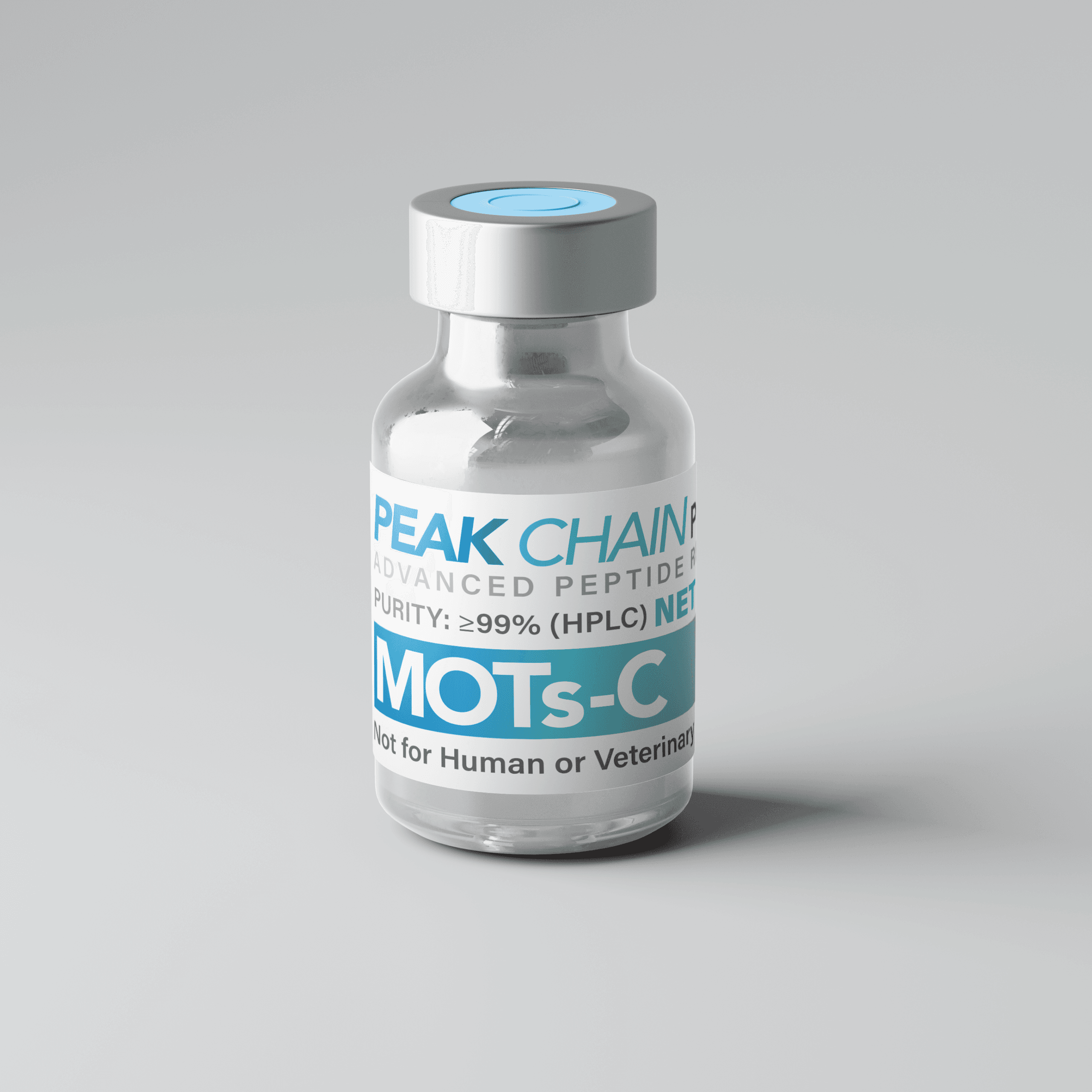
MOTs-C
Research Overview
What Is MOTs-C?
Foundational Definitions (Research Context)
Mitochondria are intracellular organelles responsible for ATP production and metabolic regulation. Beyond energy generation, mitochondria function as signaling centers that influence oxidative stress responses, inflammatory signaling, and metabolic adaptation. Reviews of mitochondrial-derived peptides describe mitochondria as endocrine-like regulators capable of producing bioactive peptides such as MOTs-C.
https://pubmed.ncbi.nlm.nih.gov/31214116/
AMP-Activated Protein Kinase (AMPK) is a cellular energy sensor activated when ATP levels fall. AMPK promotes glucose uptake, fatty-acid oxidation, and metabolic efficiency while suppressing unnecessary energy expenditure. It is widely studied in metabolic and insulin resistance models.
https://pubmed.ncbi.nlm.nih.gov/25738459/
Mitonuclear Communication refers to signaling from mitochondria to the nucleus that alters gene expression during metabolic stress. This concept is central to understanding how cells adapt to energy imbalance.
https://pubmed.ncbi.nlm.nih.gov/29983246/
Overview
MOTs-C is a 16-amino-acid peptide encoded within mitochondrial DNA. It was first characterized in 2015 as a regulator of metabolic homeostasis and insulin sensitivity, demonstrating that mitochondria encode signaling peptides capable of influencing systemic metabolism.
https://pubmed.ncbi.nlm.nih.gov/25738459/
MOTs-C is classified as a mitochondrial-derived peptide (MDP) and has since been investigated in metabolism, aging biology, and mitochondrial stress research.
Mechanistic Research Findings
Nuclear Translocation Under Stress
Experimental work demonstrated that MOTs-C can translocate to the nucleus during metabolic stress and regulate stress-responsive gene programs, providing direct evidence of mitochondrial-to-nuclear signaling.
https://pubmed.ncbi.nlm.nih.gov/29983246/
Metabolic Phenotypes in Obesity Models
Metabolomics research in obese mouse models showed that MOTs-C administration altered plasma metabolic pathways and was associated with improved insulin sensitivity phenotypes in that experimental context.
https://pubmed.ncbi.nlm.nih.gov/31293078/
Human Observational Research
Circulating MOTs-C has been measured in human populations and shown to respond to metabolic cues, including lipid and insulin-related regulation, supporting its role as a metabolically responsive peptide in humans.
https://pubmed.ncbi.nlm.nih.gov/31066084/
Lower circulating MOTs-C levels have been associated with impaired coronary endothelial function in human cohorts, linking mitochondrial peptide biology to vascular research phenotypes (association-level evidence).
https://pubmed.ncbi.nlm.nih.gov/29242099/
Aging & Muscle Biology
Research in aging men demonstrated differences in plasma and skeletal muscle MOTs-C expression across age groups, contributing to understanding of mitochondrial peptide regulation in human aging.
https://pubmed.ncbi.nlm.nih.gov/32182209/
In preclinical work, MOTs-C has been described as an exercise-induced mitochondrial-encoded peptide associated with physical performance and healthspan-related findings in mouse models.
https://pubmed.ncbi.nlm.nih.gov/33473109/
Research Applications
Based on verified published studies, MOTs-C is studied in laboratory models involving:
- Mitochondrial signaling and mitonuclear communication
- Metabolic regulation and insulin sensitivity phenotypes
- Plasma metabolite pathway remodeling in obesity models
- Circulating mitochondrial peptides in human metabolic research
- Endothelial function associations
- Aging muscle biology and exercise adaptation
Simply Put
Your cells have tiny power plants called mitochondria. MOTs-C is a small signal made from the mitochondria’s own DNA. Scientists study it because it appears to help cells respond when energy is low or when the body is under metabolic stress.
Rather than forcing more energy production, MOTs-C research focuses on how cells adjust fuel use and adapt to stress. That’s why it’s studied in metabolism, aging, and exercise research settings.
Additional Scientific Research Information
Lee C, Zeng J, Drew BG, et al. “The Mitochondrial-Derived Peptide MOTs-C Promotes Metabolic Homeostasis and Reduces Obesity and Insulin Resistance.” Cell Metabolism, 2015.
DOI: 10.1016/j.cmet.2015.02.009
Reynolds JC, Lai RW, Woodhead JST, et al. “MOTs-C is an exercise-induced mitochondrial-encoded regulator of age-dependent physical decline and muscle homeostasis.” Nature Communications, 2021.
DOI: 10.1038/s41467-020-20790-0
Kim KH, Son JM, Benayoun BA, Lee C. “The mitochondrial-encoded peptide MOTs-C translocates to the nucleus to regulate nuclear gene expression in response to metabolic stress.” Cell Metabolism, 2018.
DOI: 10.1016/j.cmet.2018.06.008
Kim SJ, Miller B, Kumagai H, et al. “The mitochondrial-derived peptide MOTs-C is a regulator of plasma metabolites and enhances insulin sensitivity.” Physiological Reports, 2019.
Kumagai H, Coelho AR, Wan J, et al. “MOTs-C reduces myostatin and muscle atrophy signaling.” American Journal of Physiology Endocrinology and Metabolism, 2021.
DOI: 10.1152/ajpendo.00275.2020
Ming W, Lu G, Xin S, et al. “MOTs-C protects against ovariectomy-induced bone loss by regulating osteoclast activity.” Biochemical and Biophysical Research Communications, 2016.
DOI: 10.1016/j.bbrc.2016.05.135
Kong BS, Lee H, L’Yi S, et al. “Mitochondrial-encoded peptide MOTs-C prevents pancreatic islet cell senescence to delay diabetes.” Experimental and Molecular Medicine, 2025.
DOI: 10.1038/s12276-025-01521-1
Fuku N, Pareja-Galeano H, Zempo H, et al. “The mitochondrial-derived peptide MOTs-C: a player in exceptional longevity?” Aging Cell, 2015.
Mohtashami Z, Singh MK, Taye N, et al. “MOTs-C, the Most Recent Mitochondrial Derived Peptide in Human Aging and Age-Related Diseases.” International Journal of Molecular Sciences, 2022.
USADA explainer on MOTs-C and anti-doping status.
Compliance Statement
MOTs-C is a mitochondrial-derived research peptide studied for its role in metabolic signaling, mitochondrial–nuclear communication, and cellular stress adaptation. This information is provided for educational and laboratory research purposes only. This compound is not approved for human or veterinary use.
Research Use Notice
All compounds are intended strictly for in vitro laboratory research use only. They are not intended for human or animal consumption, and no information on this page constitutes medical advice, diagnosis, or treatment.
By proceeding to purchase, you confirm that you are a qualified researcher purchasing for legitimate scientific research purposes in accordance with our Terms of Use.
You are here
Research Library
Mechanism of action, pathway data, and published literature — education first.
Next step
Product Catalog
Pricing, availability, and ordering — for qualified researchers only.
Ready to proceed?
If you have reviewed the available research and have a defined objective, you may proceed to the Product Catalog to view pricing and place an order.
Proceed to Product CatalogFor laboratory research use only · Qualified researchers only