
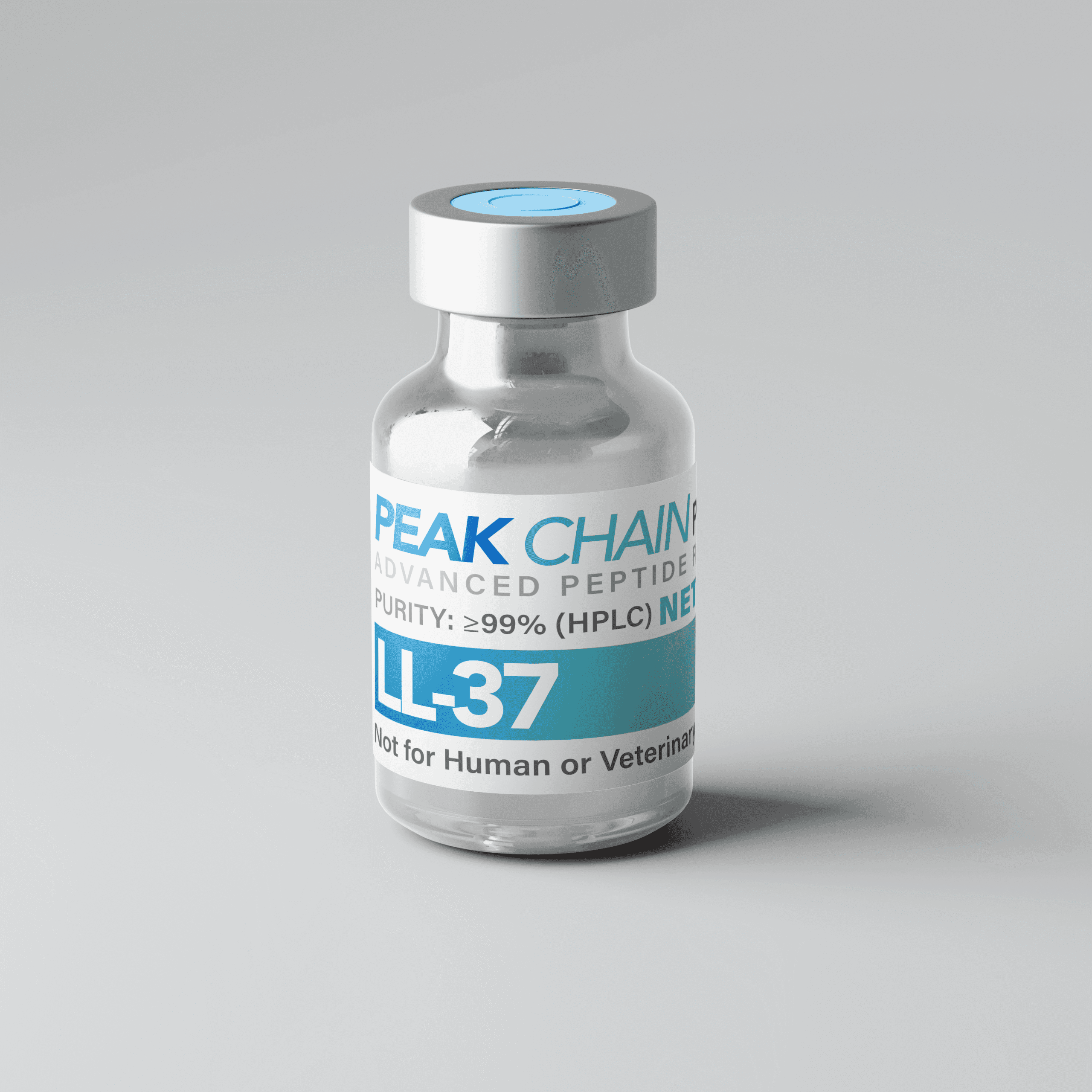
LL-37
Research Overview
What Is LL-37?
LL-37 is a human host defense peptide derived from the larger precursor protein hCAP-18 (human cathelicidin antimicrobial peptide). It is part of the innate immune system and is naturally produced by epithelial cells, neutrophils, macrophages, and other immune-related tissues.
LL-37 is classified as a cationic amphipathic peptide, meaning it carries a positive charge and can interact directly with microbial membranes and cellular signaling pathways.
https://www.ncbi.nlm.nih.gov/pmc/articles/PMC6163495/
Key structural note:
LL-37 contains 37 amino acids and begins with two leucines (“LL”), which is where its name originates.
https://pubmed.ncbi.nlm.nih.gov/10419835/
Mechanism of Action (Scientific Overview)
Antimicrobial Activity
LL-37 has been shown in vitro to disrupt bacterial, viral, and fungal membranes through electrostatic interactions. Its positive charge allows it to bind to negatively charged microbial membranes, leading to membrane destabilization and cell death.
https://www.ncbi.nlm.nih.gov/pmc/articles/PMC3693545/
Immune Modulation
Beyond direct antimicrobial effects, LL-37 acts as an immune signaling modulator:
- Chemotaxis of immune cells (neutrophils, monocytes, T cells)
- Regulation of cytokine release
- Modulation of inflammatory signaling pathways
These effects are receptor-mediated and context-dependent rather than purely antimicrobial.
https://www.ncbi.nlm.nih.gov/pmc/articles/PMC6200434/
Barrier & Tissue Signaling
LL-37 has been shown to interact with epithelial cells, influencing barrier integrity, wound response signaling, and angiogenic pathways in experimental systems.
https://www.ncbi.nlm.nih.gov/pmc/articles/PMC6737423/
Simply Put (Plain-English Explanation)
Think of LL-37 as part of your body’s first-response defense team.
Before antibodies or specialized immune cells even show up, LL-37 is already present in places like the skin, lungs, and gut—helping:
- Poke holes in invading microbes
- Call immune cells to the area
- Help tissues communicate during stress or injury
It doesn’t just “kill germs.” It also helps coordinate how the immune system reacts, which is why researchers find it interesting beyond infection models.
Research Areas of Interest
Innate Immunity Models
LL-37 is widely studied in innate immune response research, particularly how the body recognizes and reacts to pathogens without prior exposure.
https://www.ncbi.nlm.nih.gov/pmc/articles/PMC6737423/
Inflammation & Immune Balance
Researchers investigate LL-37’s dual role in both pro-inflammatory and regulatory signaling, depending on tissue environment and concentration.
https://www.ncbi.nlm.nih.gov/pmc/articles/PMC6200434/
Tissue Repair & Angiogenesis Research
Preclinical models have explored LL-37’s involvement in cell migration, vascular signaling, and epithelial regeneration pathways.
https://www.ncbi.nlm.nih.gov/pmc/articles/PMC3693545/
Microbiome & Barrier Defense
LL-37 is frequently studied in the context of skin, gut, and respiratory barrier function, where it may influence microbial balance and epithelial signaling.
https://www.ncbi.nlm.nih.gov/pmc/articles/PMC6163495/
Key Characteristics for Researchers
- Endogenous human peptide (naturally occurring)
- Broad interaction with immune and epithelial cells
- Context-dependent biological effects
- Not limited to direct antimicrobial activity
These characteristics make LL-37 useful in mechanistic research, rather than single-pathway studies.
https://pubmed.ncbi.nlm.nih.gov/10419835/
Additional Scientific Research Information
LL-37 is the only human cathelicidin antimicrobial peptide identified in humans. It is generated from a larger precursor protein called hCAP18 (encoded by the CAMP gene) and is a key component of the body’s innate immune system, meaning it acts as a rapid, first-line defense before the adaptive immune system fully activates. LL-37 is produced in tissues such as the skin, respiratory tract, neutrophils, epithelial cells, and immune cells, particularly during infection or inflammatory stress.
https://pubmed.ncbi.nlm.nih.gov/20600427/
In plain language, LL-37 is a defense-and-repair peptide. It not only helps the body fight microbes but also supports immune signaling, inflammation balance, tissue protection, and wound healing.
What LL-37 does
1. Direct antimicrobial activity
LL-37 is a cationic, amphipathic peptide, meaning it can bind to and disrupt negatively charged microbial membranes. This allows it to act directly against a wide range of pathogens, including Gram-positive bacteria, Gram-negative bacteria, fungi, and some viruses.
https://pmc.ncbi.nlm.nih.gov/articles/PMC4485164/
Simply Put: LL-37 acts like a natural antimicrobial barrier, helping damage invading organisms before they spread.
https://pubmed.ncbi.nlm.nih.gov/26434733/
2. Anti-biofilm effects
LL-37 has demonstrated the ability to interfere with biofilm formation, including disruption of bacterial attachment and communication systems such as quorum sensing. This is particularly relevant in organisms like Pseudomonas aeruginosa, which are known for forming persistent infections.
https://pubmed.ncbi.nlm.nih.gov/36781570/
Simply Put: some bacteria form a protective “shield” that makes them harder to remove. LL-37 has been studied for its ability to prevent or break down that shield.
https://pmc.ncbi.nlm.nih.gov/articles/PMC8227053/
3. Immune cell recruitment and signaling
LL-37 functions as a signaling molecule that can attract immune cells including neutrophils, monocytes, and T cells through receptor pathways such as FPR2/FPRL1. This helps coordinate immune response location and intensity.
https://pubmed.ncbi.nlm.nih.gov/11015447/
Simply Put: LL-37 helps the body call immune cells to where they are needed, acting like a directional signal during infection or injury.
https://pubmed.ncbi.nlm.nih.gov/23246832/
4. Inflammation modulation
LL-37 has a context-dependent role in inflammation, meaning it can either promote or suppress inflammatory signaling depending on the environment. It has also been shown to bind and neutralize lipopolysaccharide (LPS), a major inflammatory toxin from Gram-negative bacteria.
https://pubmed.ncbi.nlm.nih.gov/22028895/
Simply Put: LL-37 works more like a regulator than a switch, helping either activate or calm the immune response depending on what the body needs.
https://pubmed.ncbi.nlm.nih.gov/29843147/
5. Wound healing and tissue repair
LL-37 plays a significant role in tissue repair by promoting keratinocyte migration, re-epithelialization, and cellular signaling involved in wound closure. It has been shown to activate pathways such as EGFR transactivation via HB-EGF, which are important for regeneration.
https://pubmed.ncbi.nlm.nih.gov/16177113/
Simply Put: LL-37 helps the body rebuild damaged tissue, especially by helping skin cells move and cover injured areas.
https://pubmed.ncbi.nlm.nih.gov/21693141/
6. Angiogenesis
LL-37 has been shown to promote angiogenesis, the formation of new blood vessels. This is critical in healing because tissues require oxygen and nutrients delivered through blood flow.
https://pmc.ncbi.nlm.nih.gov/articles/PMC156109/
Simply Put: LL-37 may help the body restore circulation to damaged areas, improving healing efficiency.
https://pubmed.ncbi.nlm.nih.gov/23840194/
How the body naturally regulates LL-37
LL-37 production is regulated through the CAMP gene and is influenced by immune signaling pathways, including vitamin D-dependent mechanisms. Research has shown that vitamin D can induce LL-37 expression in immune cells such as macrophages.
https://pubmed.ncbi.nlm.nih.gov/19748465/
Simply Put: LL-37 production is controlled by the body, and vitamin D is one of the signals that can increase its levels.
https://pubmed.ncbi.nlm.nih.gov/17675463/
Why researchers care about LL-37
LL-37 is of strong interest because it connects multiple biological systems, including:
- infection control
- immune signaling
- barrier defense
- inflammation regulation
- tissue repair and regeneration
This combination makes it a multifunctional host-defense peptide rather than a single-purpose molecule.
https://pubmed.ncbi.nlm.nih.gov/23840194/
Additional research highlights include:
- chronic wound environments
- biofilm-associated infections
- epithelial barrier function
- peptide stabilization and delivery systems
https://pubmed.ncbi.nlm.nih.gov/41270816/
Human clinical context
LL-37 has been evaluated in human studies, particularly in topical wound applications. A randomized controlled trial in diabetic foot ulcers demonstrated improved healing outcomes, and additional studies have evaluated LL-37 in venous leg ulcers.
https://pubmed.ncbi.nlm.nih.gov/37480520/
Simply Put: LL-37 has moved beyond lab research and is being studied in real-world wound healing settings, although broader clinical use is still developing.
https://pubmed.ncbi.nlm.nih.gov/34687253/
Important limitations and cautions
LL-37 is a powerful but complex peptide. Key limitations include:
- potential cell toxicity at high concentrations
- rapid degradation in biological environments
- context-dependent effects across different tissues and diseases
These factors are why research continues into LL-37 analogs, fragments, and delivery systems rather than relying solely on native LL-37.
https://pubmed.ncbi.nlm.nih.gov/26175965/
Simply Put: LL-37 is not universally beneficial in every situation. Its effects depend heavily on
dose, environment, and biological context.
https://pubmed.ncbi.nlm.nih.gov/26395996/
Simple summary
LL-37 is a human host-defense peptide derived from hCAP18 that plays roles in:
- antimicrobial activity
- biofilm disruption
- immune cell recruitment
- inflammation modulation
- endotoxin neutralization
- tissue repair and angiogenesis
In simple terms, LL-37 functions as a multi-purpose defense, signaling, and repair molecule within the body.
https://pubmed.ncbi.nlm.nih.gov/26395996/
Additional research links
https://pubmed.ncbi.nlm.nih.gov/34687253/
https://pubmed.ncbi.nlm.nih.gov/37480520/
https://pubmed.ncbi.nlm.nih.gov/41270816/
https://pmc.ncbi.nlm.nih.gov/articles/PMC8227053/
https://pmc.ncbi.nlm.nih.gov/articles/PMC4485164/
This is educational research information only.
Compliance & Research-Use Statement
LL-37 is supplied for laboratory research and educational purposes only.
It is not approved for use in diagnosing, treating, curing, or preventing any disease.
All information presented reflects published scientific literature and is intended to support independent research exploration.
Research Use Notice
All compounds are intended strictly for in vitro laboratory research use only. They are not intended for human or animal consumption, and no information on this page constitutes medical advice, diagnosis, or treatment.
By proceeding to purchase, you confirm that you are a qualified researcher purchasing for legitimate scientific research purposes in accordance with our Terms of Use.
You are here
Research Library
Mechanism of action, pathway data, and published literature — education first.
Next step
Product Catalog
Pricing, availability, and ordering — for qualified researchers only.
Ready to proceed?
If you have reviewed the available research and have a defined objective, you may proceed to the Product Catalog to view pricing and place an order.
Proceed to Product CatalogFor laboratory research use only · Qualified researchers only