
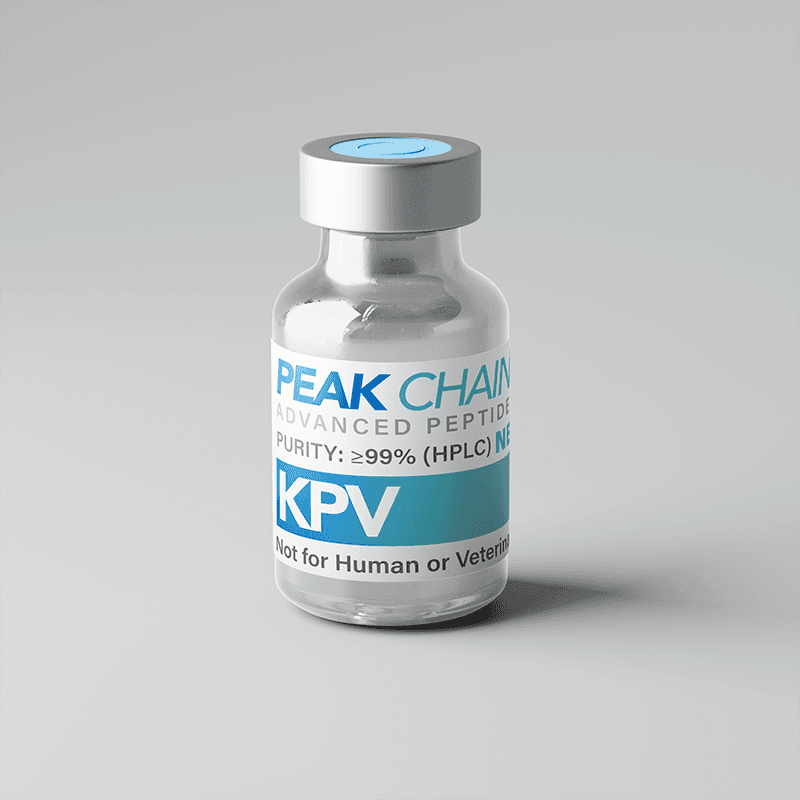
KPV
Research Overview
What Is KPV?
KPV (Lysine-Proline-Valine) is a naturally occurring tripeptide representing the C-terminal fragment of α-melanocyte-stimulating hormone (α-MSH). α-MSH is part of the melanocortin system, a biologic network involved in immune modulation, pigmentation, energy balance, and inflammatory regulation.
Unlike the full α-MSH hormone, KPV is a much smaller fragment that retains certain anti-inflammatory and immunomodulatory properties while lacking the hormonal melanocortin receptor activity associated with pigmentation changes.
Foundational work describing melanocortin peptide biology and anti-inflammatory signaling:
https://pmc.ncbi.nlm.nih.gov/articles/PMC2095288/
In Simple Terms
KPV is a tiny piece of a larger natural hormone. Researchers study it because this small fragment appears to help calm inflammation, especially in the digestive tract, without acting like a full hormone.
Molecular Mechanisms of Action
1. PepT1-Mediated Transport (Targeted Gut Uptake)
One of the most important discoveries about KPV is that it is transported into intestinal epithelial cells by PepT1 (SLC15A1), a di- and tripeptide transporter.
PepT1 expression is significantly upregulated in inflamed intestinal tissue, particularly in inflammatory bowel disease (IBD) models. Research has shown that KPV’s anti-inflammatory effects are reduced or abolished when PepT1 transport is absent or blocked, demonstrating that KPV’s activity in the gut is transport-dependent.
Primary mechanistic study (Gastroenterology):
https://pmc.ncbi.nlm.nih.gov/articles/PMC2431115/
Why This Matters for Researchers
PepT1 targeting provides a model for:
- Studying inflamed epithelial transport dynamics
- Designing colon-targeted peptide therapies
- Investigating transporter-guided drug delivery
In Plain Language
When the gut is inflamed, it expresses more “peptide doorways.” KPV can use those doorways to get inside cells and reduce inflammation from within.
2. Downregulation of Pro-Inflammatory Cytokines
Experimental studies show that KPV reduces the expression of inflammatory mediators such as TNF-α, IL-1β, and other cytokines involved in intestinal inflammation.
Mechanistically, these effects are often linked to suppression of NF-κB–related inflammatory transcription pathways, though exact upstream interactions can vary by model.
PepT1-linked anti-inflammatory signaling data:
https://pmc.ncbi.nlm.nih.gov/articles/PMC2431115/
Additional inflammatory signaling and melanocortin system review:
https://www.mdpi.com/2073-4409/12/14/1889
In Simple Terms
KPV appears to help “turn down” the body’s inflammatory alarm signals in laboratory models.
3. Intestinal Barrier Function and Mucosal Integrity
Research on KPV frequently evaluates its effects on:
- Tight junction proteins
- Epithelial permeability
- Mucosal healing
- Histologic colitis scoring
Multiple preclinical delivery studies show improved mucosal integrity and reduced inflammatory damage when KPV is delivered directly to inflamed colon tissue.
Nanoparticle and hydrogel delivery models in ulcerative colitis research:
https://pmc.ncbi.nlm.nih.gov/articles/PMC5498804/
Colitis-associated tumorigenesis and PepT1-transported KPV:
https://pmc.ncbi.nlm.nih.gov/articles/PMC4957955/
In Plain Language
In animal studies, KPV helped the gut lining stay tighter and less damaged during inflammation.
4. Antimicrobial and Antifungal Research (KPV-Derived Peptides)
KPV and especially KPV-derived peptides such as (CKPV)₂ (CZEN-002) have demonstrated antifungal activity, particularly against Candida species in vitro and in animal models.
The mechanism appears to differ from traditional membrane-disrupting antimicrobial peptides and may involve immunomodulatory effects alongside antifungal activity.
Rat Candida vaginitis model study:
https://journals.plos.org/plosone/article?id=10.1371/journal.pone.0056004
Review of antimicrobial peptide development and CZEN-002:
https://pmc.ncbi.nlm.nih.gov/articles/PMC7533533/
In Simple Terms
Some modified versions of KPV have been studied for fighting yeast infections in research models.
Human Clinical Evidence
Human clinical data for KPV alone is limited. Most available human data involve KPV-derived compounds such as CZEN-002.
A Phase I/IIa clinical experience in vulvovaginal candidiasis was reported in early development literature, with favorable tolerability in small cohorts.
Clinical summary review:
https://pmc.ncbi.nlm.nih.gov/articles/PMC7533533/
Important Research Context
There are currently no large modern randomized Phase III trials establishing KPV as an approved therapeutic agent.
KPV remains a research peptide.
Safety and Tolerability (Preclinical Context)
Preclinical models generally describe KPV and its delivery systems as biocompatible in short-term animal experiments, with no major organ toxicity signals reported in those studies.
Hydrogel/nanoparticle tolerability data:
https://pmc.ncbi.nlm.nih.gov/articles/PMC5498804/
Research Applications
Researchers commonly investigate KPV in:
- Experimental colitis models (DSS, TNBS)
- PepT1 transporter biology
- Intestinal epithelial inflammation
- Colon-targeted peptide delivery systems
- Antifungal peptide development
PepT1 transport study:
https://pmc.ncbi.nlm.nih.gov/articles/PMC2431115/
Colitis-associated cancer research:
https://pmc.ncbi.nlm.nih.gov/articles/PMC4957955/
Emerging Research (2020s+)
Advanced peptide chemistry and inflammation-responsive conjugates incorporating KPV have been developed to improve gastrointestinal stability and controlled release.
Inflammation-triggered self-immolative conjugate research (Science Advances, 2026):
https://www.science.org/doi/10.1126/sciadv.aea2989
Melanocortin system in inflammatory disease review (2023):
https://www.mdpi.com/2073-4409/12/14/1889
Frontiers in Immunology antimicrobial peptide review:
https://www.frontiersin.org/articles/10.3389/fimmu.2020.02177/full
Additional Scientific Research Information
Dalmasso G, Charrier-Hisamuddin L, et al. PepT1-Mediated Tripeptide KPV Uptake Reduces Intestinal Inflammation. Gastroenterology, 2008
https://pubmed.ncbi.nlm.nih.gov/18061177/
Xiao B, Laroui H, et al. Orally Targeted Delivery of Tripeptide KPV via Hyaluronic Acid-Functionalized Nanoparticles Efficiently Alleviates Ulcerative Colitis. Molecular Therapy, 2017
https://pmc.ncbi.nlm.nih.gov/articles/PMC5498804/
Kannengiesser K, et al. Melanocortin-derived tripeptide KPV has anti-inflammatory effects in intestinal epithelial cells. Journal of Leukocyte Biology, 2008
https://pubmed.ncbi.nlm.nih.gov/18092346/
Catania A, et al. The peptide NDP-MSH induces protective cardiovascular effects via melanocortin receptor pathways. Journal of Leukocyte Biology, 2000
https://pubmed.ncbi.nlm.nih.gov/10652240/
Brzoska T, Luger TA, Maaser C, et al. alpha-MSH related peptides: a new class of anti-inflammatory and immunomodulating drugs. Annals of the Rheumatic Diseases, 2008
https://pubmed.ncbi.nlm.nih.gov/17934097/
Star RA, Rajora N, et al. Evidence for autocrine modulation of macrophage nitric oxide synthase by alpha-melanocyte-stimulating hormone. PNAS, 1995
https://www.pnas.org/doi/10.1073/pnas.92.17.8016
Getting SJ. Targeting melanocortin receptors as potential novel therapeutics. Pharmacology and Therapeutics, 2006
https://pubmed.ncbi.nlm.nih.gov/16488018/
Rajora N, Boccoli G, et al. alpha-MSH modulates experimental inflammatory bowel disease. Peptides, 1997
https://pubmed.ncbi.nlm.nih.gov/9145424/
Lee DJ, Kwon JY, et al. The therapeutic potential of melanocortin peptides in inflammatory bowel disease. Nature Reviews Gastroenterology & Hepatology, 2018
https://pubmed.ncbi.nlm.nih.gov/29511146/
Wang W, et al. Melanocortin Regulation of Inflammation. Frontiers in Endocrinology, 2019
https://pubmed.ncbi.nlm.nih.gov/31649620/
Recent Advances in KPV Peptide Delivery
Alpha-melanocyte-stimulating hormone (Wikipedia)
https://en.wikipedia.org/wiki/%CE%91-Melanocyte-stimulating_hormone
Summary for Researchers
KPV represents a transport-dependent, anti-inflammatory tripeptide fragment of α-MSH with:
- Strong preclinical evidence in intestinal inflammation models
- Demonstrated PepT1-mediated epithelial uptake
- Ongoing exploration in targeted delivery systems
- Early translational data via KPV-derived antifungal candidates
The strongest evidence currently exists in preclinical gastrointestinal inflammation research, with limited but notable early clinical exploration through derivative compounds.
Compliance Statement
KPV is not FDA-approved. It is supplied strictly for research use only. Any discussion provided here reflects published laboratory and early translational research.
Research Use Notice
All compounds are intended strictly for in vitro laboratory research use only. They are not intended for human or animal consumption, and no information on this page constitutes medical advice, diagnosis, or treatment.
By proceeding to purchase, you confirm that you are a qualified researcher purchasing for legitimate scientific research purposes in accordance with our Terms of Use.
You are here
Research Library
Mechanism of action, pathway data, and published literature — education first.
Next step
Product Catalog
Pricing, availability, and ordering — for qualified researchers only.
Ready to proceed?
If you have reviewed the available research and have a defined objective, you may proceed to the Product Catalog to view pricing and place an order.
Proceed to Product CatalogFor laboratory research use only · Qualified researchers only