
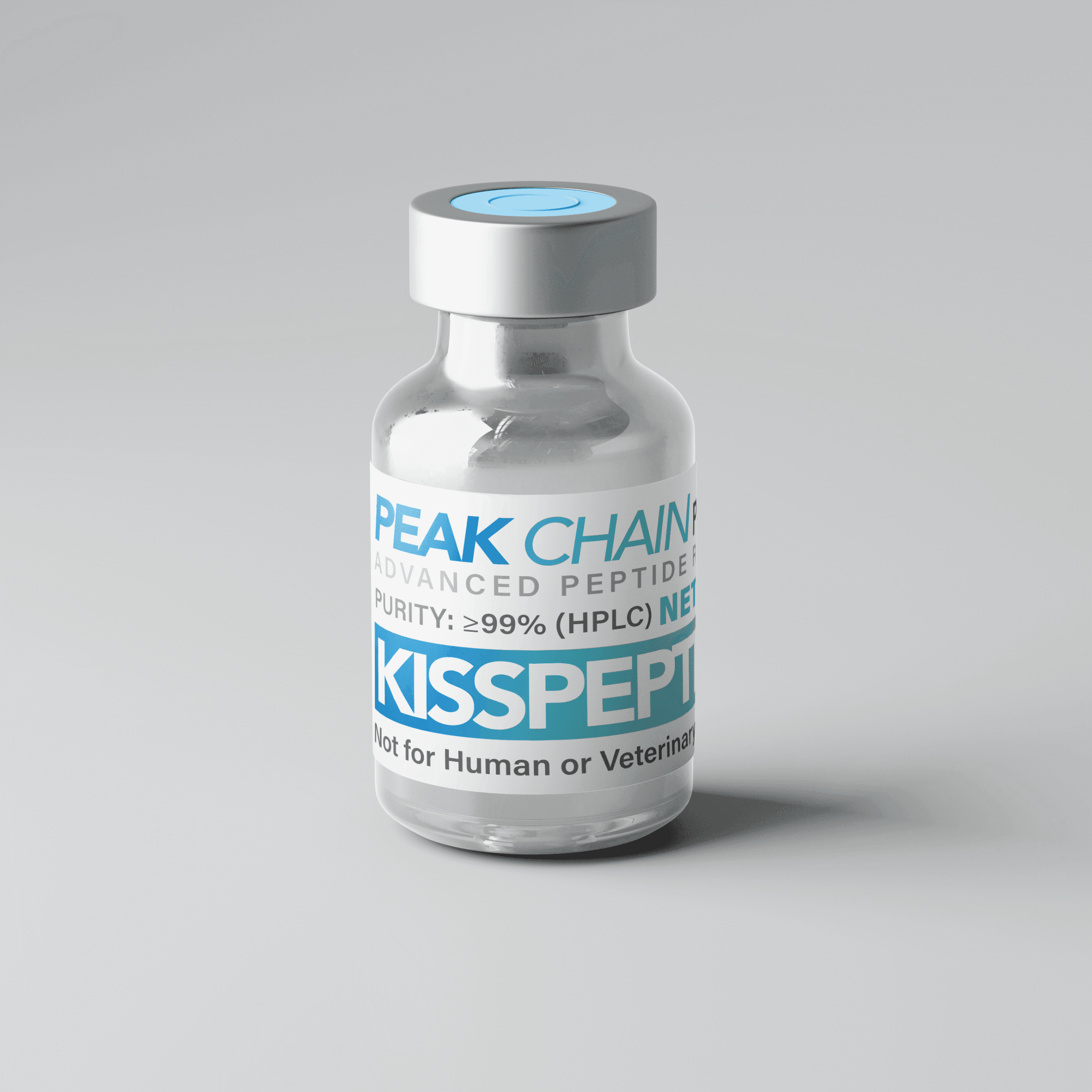
Kisspeptin
Research Overview
What Is Kisspeptin?
Kisspeptin refers to a family of endogenous neuropeptides encoded by the KISS1 gene, acting through the KISS1 receptor (KISS1R/GPR54). This signaling system is recognized as a central upstream regulator of the hypothalamic–pituitary–gonadal (HPG) axis.
Comprehensive modern physiological overview:
Front Endocrinol (Lausanne). 2022;13:925206. PMID: 35837314
https://pubmed.ncbi.nlm.nih.gov/35837314/
Updated systems-level integration and neurocircuitry analysis:
Physiol Rev. 2025;105(2):707–764. PMID: 39813600
https://pubmed.ncbi.nlm.nih.gov/39813600/
In simple terms
Kisspeptin is one of the main “on signals” that tells the brain to activate reproductive hormone communication.
Molecular and Receptor-Level Mechanism
Kisspeptin binds to the G-protein–coupled receptor KISS1R, triggering intracellular signaling cascades including:
- Phospholipase C activation
- IP3-mediated calcium mobilization
- Protein kinase C activation
- MAPK/ERK pathway signaling
These pathways ultimately stimulate GnRH neuron activation, which drives LH and FSH secretion.
Detailed receptor signaling and intracellular pathway discussion:
Adv Exp Med Biol. 2013;784:113–131. PMID: 23550004
https://pubmed.ncbi.nlm.nih.gov/23550004/
Expanded neurocircuit and signaling integration:
Adv Exp Med Biol. 2013;784:159–186. PMID: 23550006
https://pubmed.ncbi.nlm.nih.gov/23550006/
High-level mechanistic synthesis:
Endocr Rev. 2024;45(1):30–68. PMID: 37467734
https://pubmed.ncbi.nlm.nih.gov/37467734/
In simple terms
When kisspeptin binds its receptor, it flips on a chain reaction inside brain cells that ultimately tells the body to release reproductive hormones.
GnRH Pulse Generation and Neuroendocrine Control
Kisspeptin neurons are central components of the GnRH pulse generator network. Modern reviews describe how kisspeptin integrates:
- Sex steroid feedback
- Metabolic inputs
- Stress signaling
- Hypothalamic neuronal oscillations
These coordinated signals regulate LH pulse frequency and amplitude.
Comprehensive neuroendocrine network discussion:
Nat Rev Endocrinol. 2020;16(8):407–420. PMID: 32427949
https://pubmed.ncbi.nlm.nih.gov/32427949/
Updated pulse generator and systems physiology model:
Physiol Rev. 2025;105(2):707–764. PMID: 39813600
https://pubmed.ncbi.nlm.nih.gov/39813600/
In simple terms
Kisspeptin helps control the rhythm of hormone release. It acts like a conductor keeping reproductive hormones firing in the correct timing pattern.
Clinical Research in Assisted Reproduction
Kisspeptin-54 has been evaluated in human clinical studies as a physiologic trigger for endogenous LH release during IVF protocols.
Human clinical investigation of kisspeptin-54 for oocyte maturation:
Front Endocrinol (Lausanne). 2022;13:925206. PMID: 35837314
https://pubmed.ncbi.nlm.nih.gov/35837314/
Pharmacologic development and translational targeting overview:
Curr Opin Pharmacol. 2022;67:102288. PMID: 36103784
https://pubmed.ncbi.nlm.nih.gov/36103784/
These studies support kisspeptin’s ability to stimulate the reproductive axis through physiologic GnRH activation rather than direct hormone replacement.
In simple terms
Instead of giving downstream hormones directly, kisspeptin stimulates the brain to release them naturally.
Kisspeptin and Menopause
Menopause is characterized by declining ovarian estrogen production and altered hypothalamic feedback signaling. Modern endocrine reviews describe significant changes in kisspeptin neuron activity and KISS1 expression during menopausal transition.
Systems-level analysis of reproductive aging and kisspeptin neurobiology:
Endocr Rev. 2024;45(1):30–68. PMID: 37467734
https://pubmed.ncbi.nlm.nih.gov/37467734/
Integrated neuroendocrine adaptations in reproductive aging:
Physiol Rev. 2025;105(2):707–764. PMID: 39813600
https://pubmed.ncbi.nlm.nih.gov/39813600/
These publications describe how altered sex steroid feedback influences kisspeptin neuronal activity in the aging hypothalamus, contributing to changes in LH pulsatility observed during menopause.
In simple terms
During menopause, the communication between the ovaries and brain changes. Kisspeptin signaling patterns adjust as estrogen levels decline, which alters hormone rhythms.
Pharmacologic Targeting and Translational Outlook
KISS1R represents a pharmacologic target of interest for:
- Reproductive disorders
- Assisted reproduction
- Endocrine modulation strategies
Modern pharmacology reviews describe agonist and antagonist development strategies and receptor-selective approaches.
Pharmacologic targeting overview:
Curr Opin Pharmacol. 2022;67:102288. PMID: 36103784
https://pubmed.ncbi.nlm.nih.gov/36103784/
High-authority endocrine translational review:
Nat Rev Endocrinol. 2020;16(8):407–420. PMID: 32427949
https://pubmed.ncbi.nlm.nih.gov/32427949/
In simple terms
Researchers are exploring whether targeting the kisspeptin receptor could offer more precise ways to regulate reproductive hormone signaling.
Safety Observations in Clinical Literature
Human studies referenced in the 2022 Frontiers review and pharmacologic discussions report kisspeptin administration to be generally well tolerated within controlled research settings.
Clinical discussion and summary of tolerability:
Front Endocrinol (Lausanne). 2022;13:925206. PMID: 35837314
https://pubmed.ncbi.nlm.nih.gov/35837314/
Safety interpretations remain context-specific and dependent on controlled protocol design.
Compliance Statement
For laboratory research use only.
Not for human consumption.
Not intended to diagnose, treat, cure, or prevent any disease.
Research Use Notice
All compounds are intended strictly for in vitro laboratory research use only. They are not intended for human or animal consumption, and no information on this page constitutes medical advice, diagnosis, or treatment.
By proceeding to purchase, you confirm that you are a qualified researcher purchasing for legitimate scientific research purposes in accordance with our Terms of Use.
You are here
Research Library
Mechanism of action, pathway data, and published literature — education first.
Next step
Product Catalog
Pricing, availability, and ordering — for qualified researchers only.
Ready to proceed?
If you have reviewed the available research and have a defined objective, you may proceed to the Product Catalog to view pricing and place an order.
Proceed to Product CatalogFor laboratory research use only · Qualified researchers only