
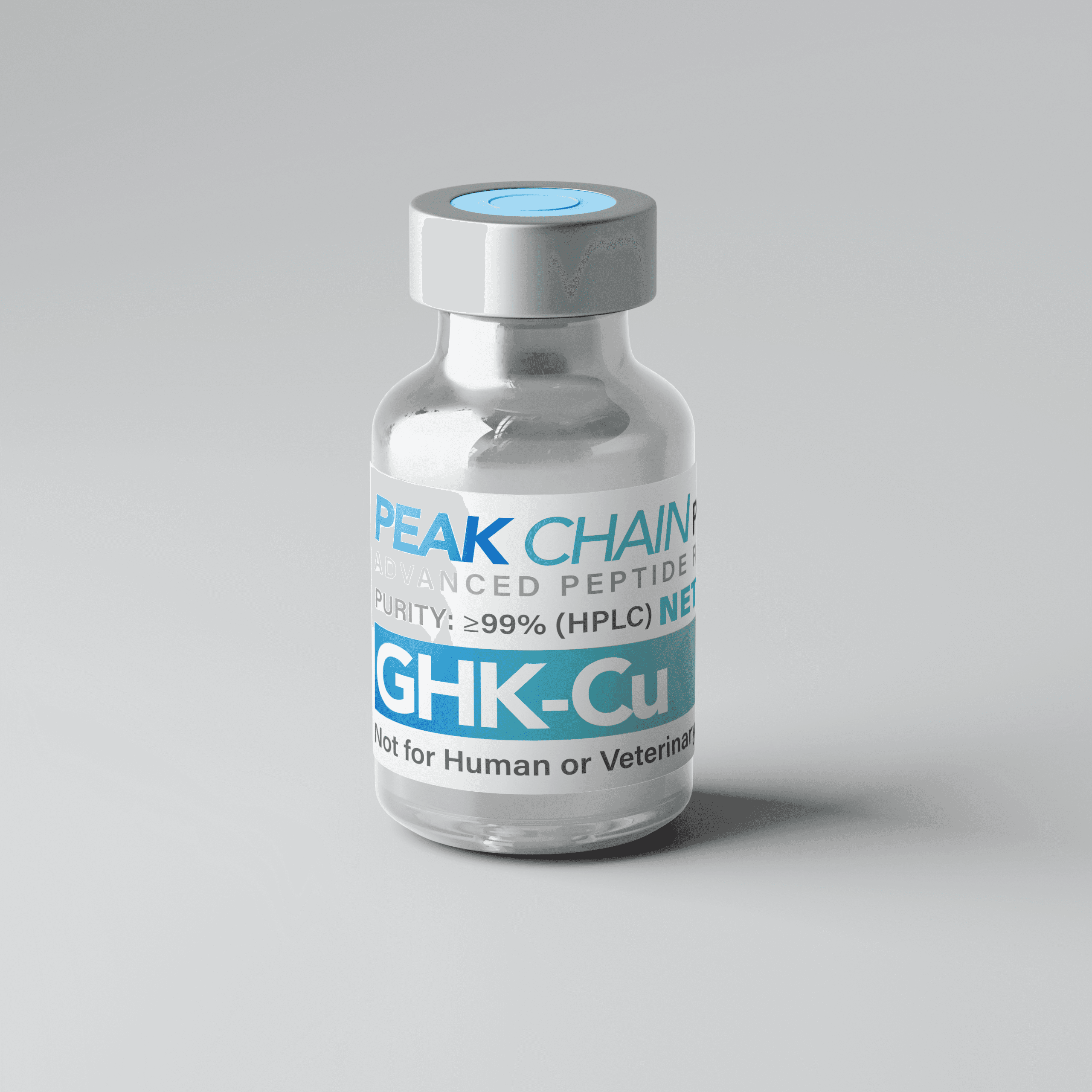
GHK-Cu
Research Overview
What Is GHK-Cu?
GHK-Cu (glycyl-L-histidyl-L-lysine copper complex) is the copper-bound form of the naturally occurring human tripeptide GHK. First studied decades ago, it has since become one of the most extensively researched regenerative signaling peptides in dermatology, wound biology, redox science, and biomaterials research.
Early foundational biochemical work helped establish GHK as a biologically active copper-binding peptide involved in tissue repair environments:
https://pubmed.ncbi.nlm.nih.gov/2244543/
Comprehensive review of GHK’s regenerative and matrix-related roles:
https://pubmed.ncbi.nlm.nih.gov/26236730/
Unlike synthetic growth factors, GHK is endogenous — meaning it naturally occurs in the body — which has contributed to long-term scientific interest.
Core Biological Role: Signaling and Structural Regulation
Research literature suggests GHK-Cu functions as a regulatory signaling peptide influencing coordinated repair pathways rather than acting as a simple stimulant.
Gene modulation and regenerative pathway influence:
https://pubmed.ncbi.nlm.nih.gov/22666519/
Molecular systems review examining signaling networks and extracellular matrix interaction:
https://pubmed.ncbi.nlm.nih.gov/29986520/
These studies describe GHK-Cu as influencing:
- Gene clusters related to repair
- Inflammatory pathway modulation
- Structural protein remodeling
- Cellular stress response systems
Simply Put:
Instead of flipping just one biological switch, GHK-Cu appears to guide multiple repair signals at once.
Gene Expression and Cellular “Reset” Activity
Large-scale gene expression profiling demonstrated that GHK can influence thousands of genes associated with tissue repair, inflammation regulation, and remodeling.
Full gene-expression analysis publication:
https://pubmed.ncbi.nlm.nih.gov/22666519/
Expanded molecular signaling review:
https://pubmed.ncbi.nlm.nih.gov/35936787/
Rather than targeting a single receptor, GHK-Cu appears to shift coordinated gene networks toward regenerative balance.
Simply Put:
Researchers describe this as helping cells shift from “damage mode” toward “repair mode.”
Skin Biology and Structural Matrix Support
Dermatologic research has shown that GHK-Cu influences fibroblast activity, collagen synthesis, and dermal structural organization.
Clinical dermatologic evaluation of copper peptide effects:
https://pubmed.ncbi.nlm.nih.gov/19319546/
Fibroblast and collagen IV findings in dermatology research:
https://pubmed.ncbi.nlm.nih.gov/37062921/
Molecular review of extracellular matrix and collagen support:
https://pubmed.ncbi.nlm.nih.gov/29986520/
These studies connect GHK-Cu to structural protein support and dermal density.
Simply Put:
Collagen is the “framework” of skin. GHK-Cu is studied for how it may help rebuild and organize that framework.
Wound Healing and Regenerative Delivery Models
GHK-Cu has been investigated in multiple wound repair systems and advanced delivery platforms.
Liposomal wound repair model:
https://pubmed.ncbi.nlm.nih.gov/28370978/
Stimuli-responsive hydrogel delivery system:
https://pubmed.ncbi.nlm.nih.gov/35341370/
Injectable regenerative matrix incorporating GHK-Cu:
https://pubmed.ncbi.nlm.nih.gov/40716276/
Controlled-release biomedical engineering platform:
https://pubmed.ncbi.nlm.nih.gov/41371501/
Across these studies, delivery system design significantly influenced biological activity and sustained repair signaling.
Simply Put:
Researchers are studying not only what GHK-Cu does — but how to deliver it in smarter ways so repair signals last longer.
Oxidative Stress and Redox Regulation
Modern redox biology research examines GHK-Cu’s influence on oxidative stress pathways and inflammatory cascades.
Pulmonary fibrosis and oxidative stress model:
https://pubmed.ncbi.nlm.nih.gov/31809714/
NF-κB / Nrf2 signaling pathway involvement:
https://pubmed.ncbi.nlm.nih.gov/35936787/
Redox Biology publication examining oxidative regulation mechanisms:
https://pubmed.ncbi.nlm.nih.gov/38879894/
These studies describe GHK-Cu interacting with redox-sensitive signaling networks and inflammatory mediators.
Simply Put:
Oxidative stress is cellular “wear and tear.” These studies explore whether GHK-Cu helps cells stay more balanced under stress.
Biomaterials and Advanced Tissue Engineering
Recent biomedical engineering publications expand GHK-Cu research into regenerative scaffolds and targeted copper delivery systems.
Polymer gel and scaffold integration research:
https://pubmed.ncbi.nlm.nih.gov/35341370/
Soft tissue regenerative delivery system:
https://pubmed.ncbi.nlm.nih.gov/40716276/
Golgi-targeted copper delivery and fascia regeneration platform:
https://pubmed.ncbi.nlm.nih.gov/41371501/
These studies demonstrate that GHK-Cu retains biological function when integrated into modern biomaterial systems.
Simply Put:
Scientists are pairing GHK-Cu with advanced materials so its regenerative signals can be directed exactly where needed.
Additional Scientific Research Information
(GHK-Cu Specific Publications for Continued Study)
Adv Exp Med Biol. 1990
https://pubmed.ncbi.nlm.nih.gov/2244543/
Biomed Res Int. 2015
https://pubmed.ncbi.nlm.nih.gov/26236730/
Arch Dermatol Res. 2009
https://pubmed.ncbi.nlm.nih.gov/19319546/
Oxid Med Cell Longev. 2012
https://pubmed.ncbi.nlm.nih.gov/22666519/
Int J Mol Sci. 2018
https://pubmed.ncbi.nlm.nih.gov/29986520/
Wound Repair Regen. 2017
https://pubmed.ncbi.nlm.nih.gov/28370978/
Life Sci. 2020
https://pubmed.ncbi.nlm.nih.gov/31809714/
Front Mol Biosci. 2022
https://pubmed.ncbi.nlm.nih.gov/35936787/
J Biomater Appl. 2022
https://pubmed.ncbi.nlm.nih.gov/35341370/
Colloids Surf B Biointerfaces. 2025
https://pubmed.ncbi.nlm.nih.gov/40716276/
Redox Biol. 2024
https://pubmed.ncbi.nlm.nih.gov/38879894/
J Control Release. 2026
https://pubmed.ncbi.nlm.nih.gov/41371501/
J Cosmet Dermatol. 2023
https://pubmed.ncbi.nlm.nih.gov/37062921/
Pickart L, Vasquez-Soltero JM, Margolina A. GHK Peptide as a Natural Modulator of Multiple Cellular Pathways in Skin Regeneration. BioMed Research International, 2015.
https://pubmed.ncbi.nlm.nih.gov/26236730/
https://pmc.ncbi.nlm.nih.gov/articles/PMC4508379/
Pickart L, Margolina A. Regenerative and Protective Actions of the GHK-Cu Peptide in the Light of the New Gene Data. International Journal of Molecular Sciences, 2018.
https://pubmed.ncbi.nlm.nih.gov/29986520/
https://pmc.ncbi.nlm.nih.gov/articles/PMC6073405/
Pickart L, Vasquez-Soltero JM, Margolina A. GHK and DNA: Resetting the Human Genome to Health. BioMed Research International, 2014.
https://pubmed.ncbi.nlm.nih.gov/25302294/
https://pmc.ncbi.nlm.nih.gov/articles/PMC4180391/
Pickart L. The Human Tripeptide GHK-Cu in Prevention of Oxidative Stress and Degenerative Conditions of Aging. Oxidative Medicine and Cellular Longevity, 2012.
https://pubmed.ncbi.nlm.nih.gov/22666519/
https://pmc.ncbi.nlm.nih.gov/articles/PMC3359723/
Yuvan Research / McGill University. Copper Peptide Clinical Trial Summary. EurekAlert.
https://www.eurekalert.org/news-releases/990464
Maquart FX, Pickart L, et al. Stimulation of collagen synthesis in fibroblast cultures by the tripeptide-copper complex glycyl-L-histidyl-L-lysine-Cu2+. FEBS Letters, 1988.
https://pubmed.ncbi.nlm.nih.gov/3169264/
Siméon A, et al. Expression of glycosaminoglycans and small proteoglycans in wounds: modulation by the tripeptide-copper complex glycyl-L-histidyl-L-lysine-Cu(2+). Journal of Investigative Dermatology, 2000.
https://pubmed.ncbi.nlm.nih.gov/11121126/
Fu C, et al. Tripeptide-copper complex GHK-Cu (II) transiently improved healing outcome in a rat model of ACL reconstruction. Journal of Orthopaedic Research, 2015.
https://pubmed.ncbi.nlm.nih.gov/25731775/
Broad Institute. Connectivity Map (CMap).
https://www.broadinstitute.org/connectivity-map-cmap
Wikipedia. Copper peptide GHK-Cu.
https://en.wikipedia.org/wiki/Copper_peptide_GHK-Cu
Research Use Notice
GHK-Cu is intended strictly for laboratory research and educational purposes only.
Not for human consumption.
Not intended to diagnose, treat, cure, or prevent any disease.
Research Use Notice
All compounds are intended strictly for in vitro laboratory research use only. They are not intended for human or animal consumption, and no information on this page constitutes medical advice, diagnosis, or treatment.
By proceeding to purchase, you confirm that you are a qualified researcher purchasing for legitimate scientific research purposes in accordance with our Terms of Use.
You are here
Research Library
Mechanism of action, pathway data, and published literature — education first.
Next step
Product Catalog
Pricing, availability, and ordering — for qualified researchers only.
Ready to proceed?
If you have reviewed the available research and have a defined objective, you may proceed to the Product Catalog to view pricing and place an order.
Proceed to Product CatalogFor laboratory research use only · Qualified researchers only