
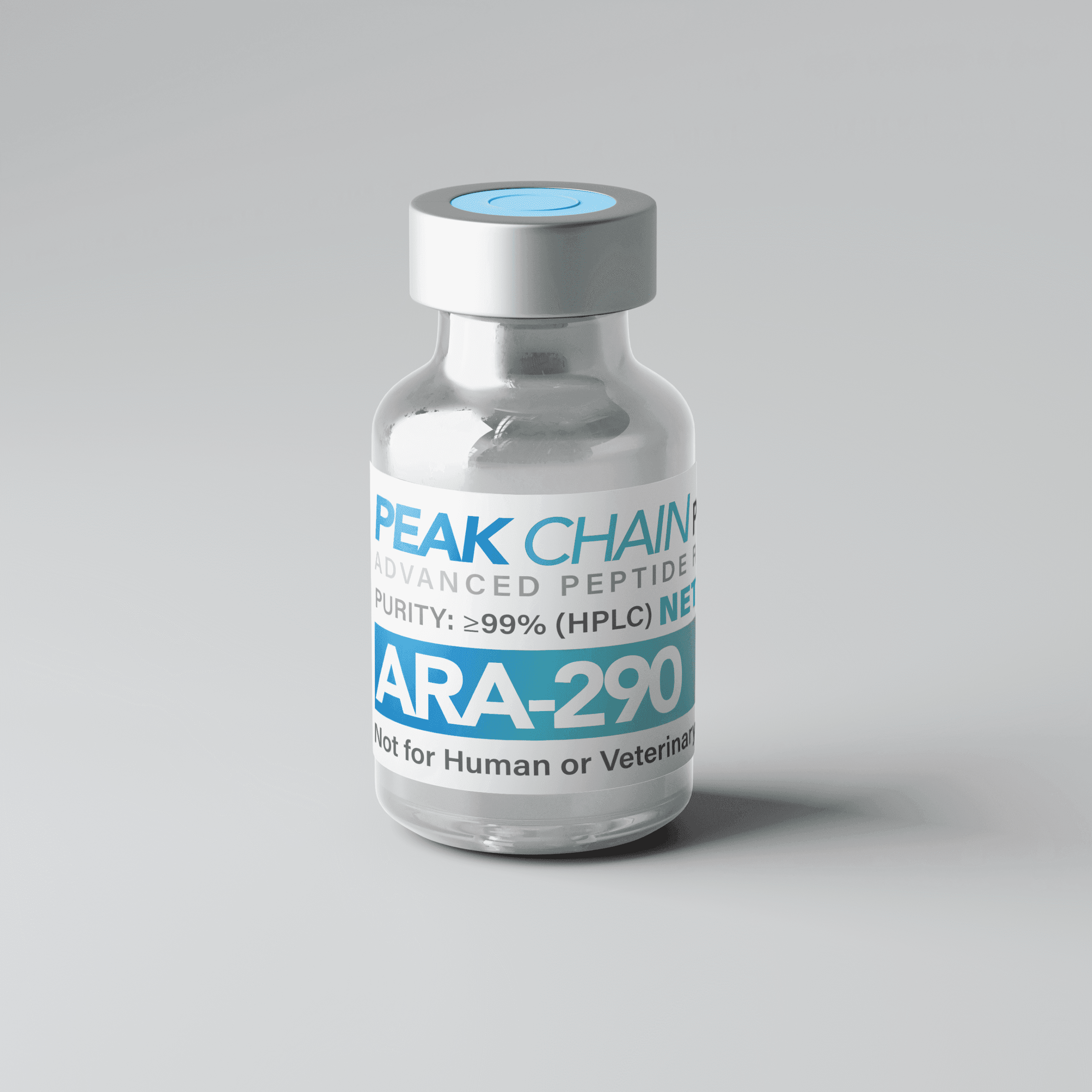
ARA-290 (Cibinetide)
Research Overview
What Is ARA-290?
ARA-290, also known as cibinetide, is a short synthetic peptide derived from a tissue-protective region of erythropoietin (EPO). It was engineered to retain EPO’s tissue-protective and anti-inflammatory signaling while avoiding erythropoietic (red blood cell–stimulating) activity, which is associated with EPO’s hematologic effects.
(Phase 2 diabetes + neuropathic symptoms paper that also explains the non-erythropoietic design rationale):
https://pmc.ncbi.nlm.nih.gov/articles/PMC4365069/
Plain-English (Simply Put) Explanation
When tissues are under stress—from inflammation, metabolic strain, or nerve irritation—cells release signals that can either promote healing or prolong damage. ARA-290 is studied as a “repair signal” that appears to help calm excessive inflammatory responses while supporting natural cellular recovery processes.
(Clinical study context in sarcoidosis-associated SFN symptoms):
https://pmc.ncbi.nlm.nih.gov/articles/PMC3563705/
Identity and Classification
ARA-290 is commonly described in the published literature as acting through a distinct receptor complex: the EPOR–CD131 heteroreceptor, often referred to as the Innate Repair Receptor (IRR). This concept is used to explain how the peptide aims to separate tissue-protective signaling from classical erythropoietic signaling.
(Review focused on IRR targeting in neuropathy context):
https://pmc.ncbi.nlm.nih.gov/articles/PMC5741312/
Proposed Mechanisms of Action
Selective Innate Repair Receptor Activation
ARA-290 preferentially activates IRR-linked signaling, which is discussed in the literature as supporting cell survival and repair pathways under tissue stress conditions.
(IRR activation and repair biology in diabetes-related wound healing research):
https://www.sciencedirect.com/science/article/pii/S0925443917304556
Modulation of Inflammatory Signaling
Preclinical and translational studies describe cibinetide as influencing innate immune cell functions in ways consistent with reducing excessive inflammatory signaling while preserving core immune activity.
(Experimental innate immune cell function paper):
https://www.nature.com/articles/s41598-017-13046-3
Neuro-Supportive and Small Fiber Nerve Effects
ARA-290 has been studied for effects on small nerve fiber abundance using objective endpoints such as corneal confocal microscopy and skin measures, alongside neuropathic symptom assessments.
(Corneal + skin small nerve fiber outcomes publication):
https://pubmed.ncbi.nlm.nih.gov/28475703/
Published Human Clinical Research
Sarcoidosis-Associated Small Fiber Neuropathy (SFN)
In a randomized, double-blind pilot study in sarcoidosis patients with SFN symptoms, ARA-290 was reported to be well tolerated and associat
ed with improvements in neuropathic symptom scoring compared with placebo over the study period.
(Pilot RCT record):
https://pubmed.ncbi.nlm.nih.gov/23168581/
Type 2 Diabetes with Neuropathic Symptoms
A phase 2 study in type 2 diabetes evaluated ARA-290 for neuropathic symptom measures and metabolic parameters, reporting improvement signals across the observation window and an overall tolerability profile within the study duration.
(PubMed record for the phase 2 study):
https://pubmed.ncbi.nlm.nih.gov/25387363/
Ophthalmology / Microvascular Research (Diabetic Macular Edema)
ARA-290 (cibinetide) has also been evaluated in a phase 2 clinical trial for diabetic macular edema, reflecting broader research interest in vascular integrity, inflammatory signaling, and tissue protection in ocular tissues.
(Phase 2 DME full text):
https://pmc.ncbi.nlm.nih.gov/articles/PMC7408632/
Safety and Research Context
ARA-290 was designed to be non-erythropoietic, distinguishing it from erythropoietin while aiming to preserve tissue-protective signaling. Human studies to date are limited in size and duration, and the compound remains investigational, requiring further controlled research to confirm durability and generalizability across populations and endpoints.
(Clinical trial registry describing dosing duration and study intent in sarcoidosis SFN):
https://clinicaltrials.gov/study/NCT02039687
Compliance-Ready Summary for Website Use
ARA-290 (cibinetide) is an investigational EPO-derived peptide designed to selectively engage repair-associated signaling linked to the EPOR–CD131 receptor complex. Published studies have explored its role in inflammation modulation, small fiber nerve biology, and tissue protection across neuropathic, metabolic, and microvascular research settings. Findings to date are preliminary and intended for scientific investigation and education only.
(Overview + mechanistic framing within human study context):
Research Use Notice
All compounds are intended strictly for in vitro laboratory research use only. They are not intended for human or animal consumption, and no information on this page constitutes medical advice, diagnosis, or treatment.
By proceeding to purchase, you confirm that you are a qualified researcher purchasing for legitimate scientific research purposes in accordance with our Terms of Use.
You are here
Research Library
Mechanism of action, pathway data, and published literature — education first.
Next step
Product Catalog
Pricing, availability, and ordering — for qualified researchers only.
Ready to proceed?
If you have reviewed the available research and have a defined objective, you may proceed to the Product Catalog to view pricing and place an order.
Proceed to Product CatalogFor laboratory research use only · Qualified researchers only