
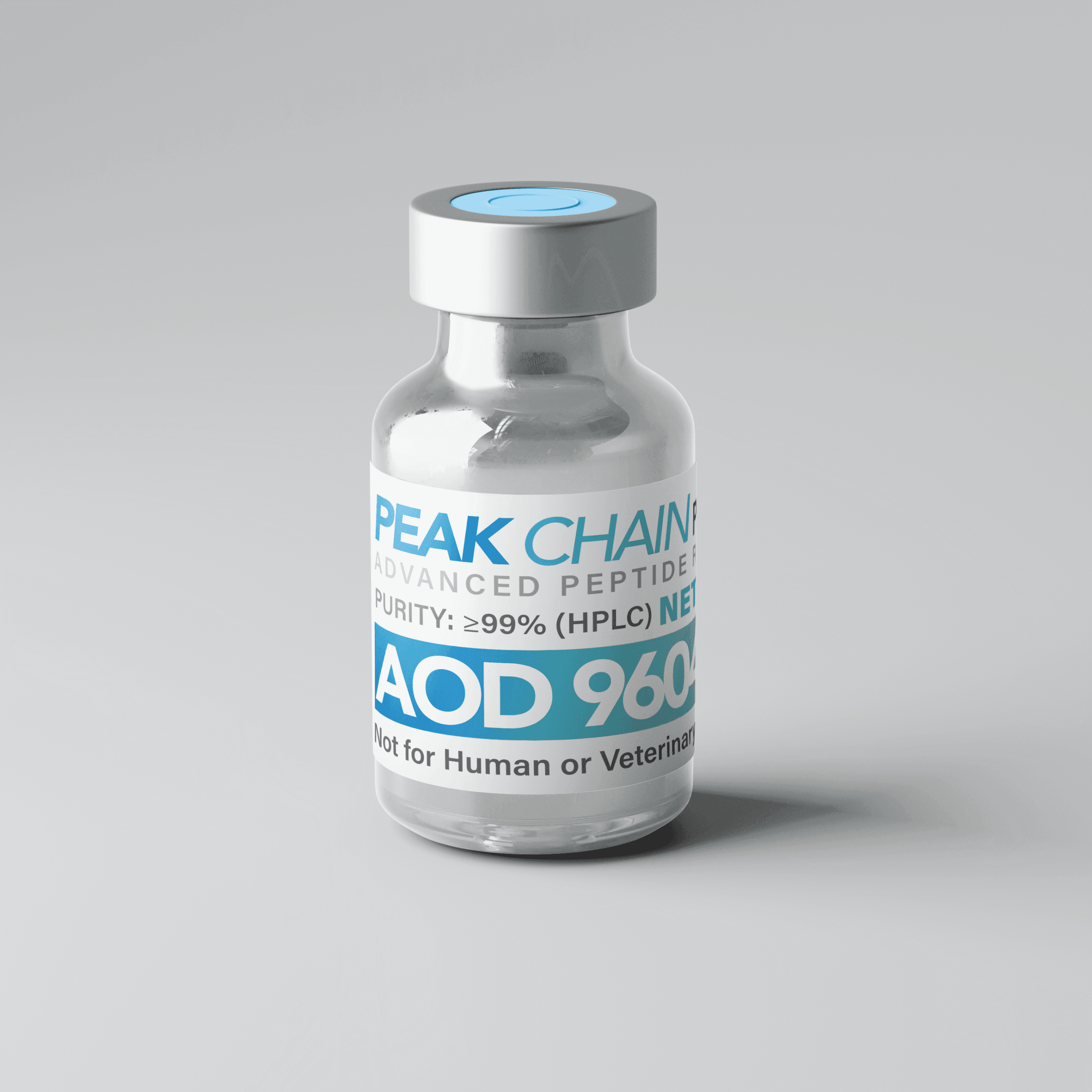
AOD-9604
Research Overview
What Is AOD-9604?
AOD-9604 is a synthetic peptide derived from amino acids 176–191 of human growth hormone (HGH). This specific segment of the HGH molecule was identified as the region responsible for lipolytic (fat-mobilizing) activity, while lacking the structural domains responsible for systemic growth promotion.
The foundational characterization of this fragment’s metabolic selectivity is described in:
https://pubmed.ncbi.nlm.nih.gov/11146367/
https://pubmed.ncbi.nlm.nih.gov/11713213/
These studies demonstrated that the 176–191 fragment retains fat-metabolic activity without reproducing the classical anabolic or diabetogenic effects of full-length HGH.
Simply Put
Researchers isolated the small portion of growth hormone that influences fat cells — and removed the parts that cause overall body growth.
Mechanism of Action — Adipose Tissue Effects
- 1. Lipolysis (Breakdown of Stored Fat)
Lipolysis is the biological process in which stored triglycerides inside fat cells are broken down into free fatty acids and glycerol for energy use.
In vivo metabolic research demonstrated that HGH fragment 176–191 increases lipolysis without stimulating body growth
https://pubmed.ncbi.nlm.nih.gov/11673763/
Cellular adipocyte studies further confirmed this lipolytic activity
https://pubmed.ncbi.nlm.nih.gov/11713213/
These findings established that fat metabolism signaling can be separated structurally from growth hormone’s anabolic effects.
Simply Put
It signals fat cells to release stored energy without affecting height, muscle size, or organ growth.
- 2. Inhibition of Lipogenesis (Reduction of New Fat Formation)
Lipogenesis refers to the conversion of excess nutrients — especially carbohydrates — into stored fat.
Experimental research demonstrated that HGH 176–191 suppresses lipogenic activity in adipose tissue
https://pubmed.ncbi.nlm.nih.gov/15134286/
This dual mechanism — stimulating fat breakdown while inhibiting new fat storage — is central to the metabolic interest in AOD-9604.
Simply Put
It may help reduce how much new fat the body creates.
Absence of Growth-Promoting and Diabetogenic Effects
Full-length growth hormone can stimulate:
- Linear growth
- Organ enlargement
- Elevation of IGF-1
- Reduced insulin sensitivity in some contexts
However, research demonstrated that the 176–191 fragment does not replicate these endocrine effects
https://pubmed.ncbi.nlm.nih.gov/11146367/
This distinction is critical to understanding why the fragment was investigated separately from full HGH.
Definitions
IGF-1 (Insulin-like Growth Factor 1) – A hormone produced downstream of HGH that mediates tissue growth.
Diabetogenic effect – A biological effect that impairs glucose control or promotes insulin resistance.
Simply Put
Unlike full growth hormone, this fragment did not trigger growth or disrupt blood sugar regulation in research models.
Clinical Development Overview
AOD-9604, developed as a stabilized analogue of HGH 176–191, progressed into formal drug development as an investigational anti-obesity compound.
A comprehensive review of its development history and early clinical findings is described here:
https://pubmed.ncbi.nlm.nih.gov/16625817/
This publication summarizes:
- Preclinical metabolic findings
- Early human safety trials
- Clinical evaluation in overweight populations
- Favorable tolerability profile
- Lack of growth-hormone–mediated side effects
While it did not ultimately achieve commercial drug approval, its safety data and selective mechanism remain scientifically relevant.
Simply Put
The fragment was tested in human trials, showed good safety, and demonstrated metabolic activity — but wasn’t strong enough to become a prescription drug.
Analytical Detection & Laboratory Differentiation
Because HGH fragments differ structurally from endogenous full-length growth hormone, analytical validation studies were performed to ensure they can be accurately identified and distinguished.
Advanced detection and differentiation of HGH-derived fragments are described in:
https://pubmed.ncbi.nlm.nih.gov/25208511/
Such analytical validation supports:
- Structural confirmation
- Laboratory detection reliability
- Differentiation from natural HGH
Simply Put
Scientists can accurately detect and distinguish this fragment from natural growth hormone in laboratory testing.
Scientific Summary (Based Strictly on Cited Publications)
From the studies cited above:
-
- HGH fragment 176–191 stimulates lipolysis
- It inhibits lipogenesis
- It lacks growth-promoting activity
- It does not demonstrate diabetogenic effects
- It progressed into investigational clinical development
- It can be analytically differentiated from full HGH
No additional claims are made beyond what the cited literature supports.
Additional Scientific Research Information
Ng FM, Sun J, Sharma L, Libinaka R, Jiang WJ, Gianello R. “Metabolic Studies of a Synthetic Lipolytic Domain (AOD9604) of Human Growth Hormone.” Hormone Research, 2000. DOI:
https://doi.org/10.1159/000053182
PubMed:
https://pubmed.ncbi.nlm.nih.gov/11146367/
Heffernan MA, Thorburn AW, Fam B, et al. “Increase of fat oxidation and weight loss in obese mice caused by chronic treatment with human growth hormone or a modified C-terminal fragment.” International Journal of Obesity, 2001. PubMed:
https://pubmed.ncbi.nlm.nih.gov/11673759/
Heffernan M, Summers RJ, Thorburn A, et al. “The effects of human GH and its lipolytic fragment (AOD9604) on lipid metabolism following chronic treatment in obese mice and beta(3)-AR knock-out mice.” Endocrinology, 2001. PubMed:
https://pubmed.ncbi.nlm.nih.gov/11713213/
Wilding JPH. “AOD-9604 Metabolic.” Current Opinion in Investigational Drugs, 2004. PubMed:
https://pubmed.ncbi.nlm.nih.gov/15134286/
Stier H, Vos E, Kenley D. “Safety and Tolerability of the Hexadecapeptide AOD9604 in Humans.” Journal of Endocrinology and Metabolism, 2013.
https://www.jofem.org/index.php/jofem/article/view/54/54
More MI, Kenley D, Gianello R. “Safety and Metabolism of AOD9604, a Novel Nutraceutical Ingredient for Improved Metabolic Health.” Journal of Endocrinology and Metabolism, 2014.
https://www.jofem.org/index.php/jofem/article/view/138/173
Kwon DR, Park GY. “Effect of Intra-articular Injection of AOD9604 with or without Hyaluronic Acid in Rabbit Osteoarthritis Model.” Annals of Clinical and Laboratory Science, 2015. PubMed:
https://pubmed.ncbi.nlm.nih.gov/26275694/
Misra M. “Obesity Pharmacotherapy: Current Perspectives and Future Directions.” Journal of Pharmacology and Pharmacotherapeutics, 2013. PMC:
https://www.ncbi.nlm.nih.gov/pmc/articles/PMC3584306/
Cox HD, Hughes CM, Eichner D. “Detection and in vitro metabolism of AOD9604.” Drug Testing and Analysis, 2014. PubMed:
https://pubmed.ncbi.nlm.nih.gov/24039232/
Journal of the American Academy of Orthopaedic Surgeons. “Therapeutic Peptides in Orthopaedics: Applications, Challenges, and Future Directions.” JAAOS, 2025. PMC:
https://www.ncbi.nlm.nih.gov/pmc/articles/PMC12753158/
FDA Pharmacy Compounding Advisory Committee (PCAC). “AOD-9604 Memorandum.” December 4, 2024.
https://www.fda.gov/media/183674/download
Wikipedia. “AOD9604”.
https://en.wikipedia.org/wiki/AOD9604
Compliance Statement
AOD-9604 is a research peptide intended solely for laboratory and scientific investigation. It is not approved for human consumption. Information provided is for educational purposes only and does not constitute medical advice or therapeutic claims.
Research Use Notice
All compounds are intended strictly for in vitro laboratory research use only. They are not intended for human or animal consumption, and no information on this page constitutes medical advice, diagnosis, or treatment.
By proceeding to purchase, you confirm that you are a qualified researcher purchasing for legitimate scientific research purposes in accordance with our Terms of Use.
You are here
Research Library
Mechanism of action, pathway data, and published literature — education first.
Next step
Product Catalog
Pricing, availability, and ordering — for qualified researchers only.
Ready to proceed?
If you have reviewed the available research and have a defined objective, you may proceed to the Product Catalog to view pricing and place an order.
Proceed to Product CatalogFor laboratory research use only · Qualified researchers only