
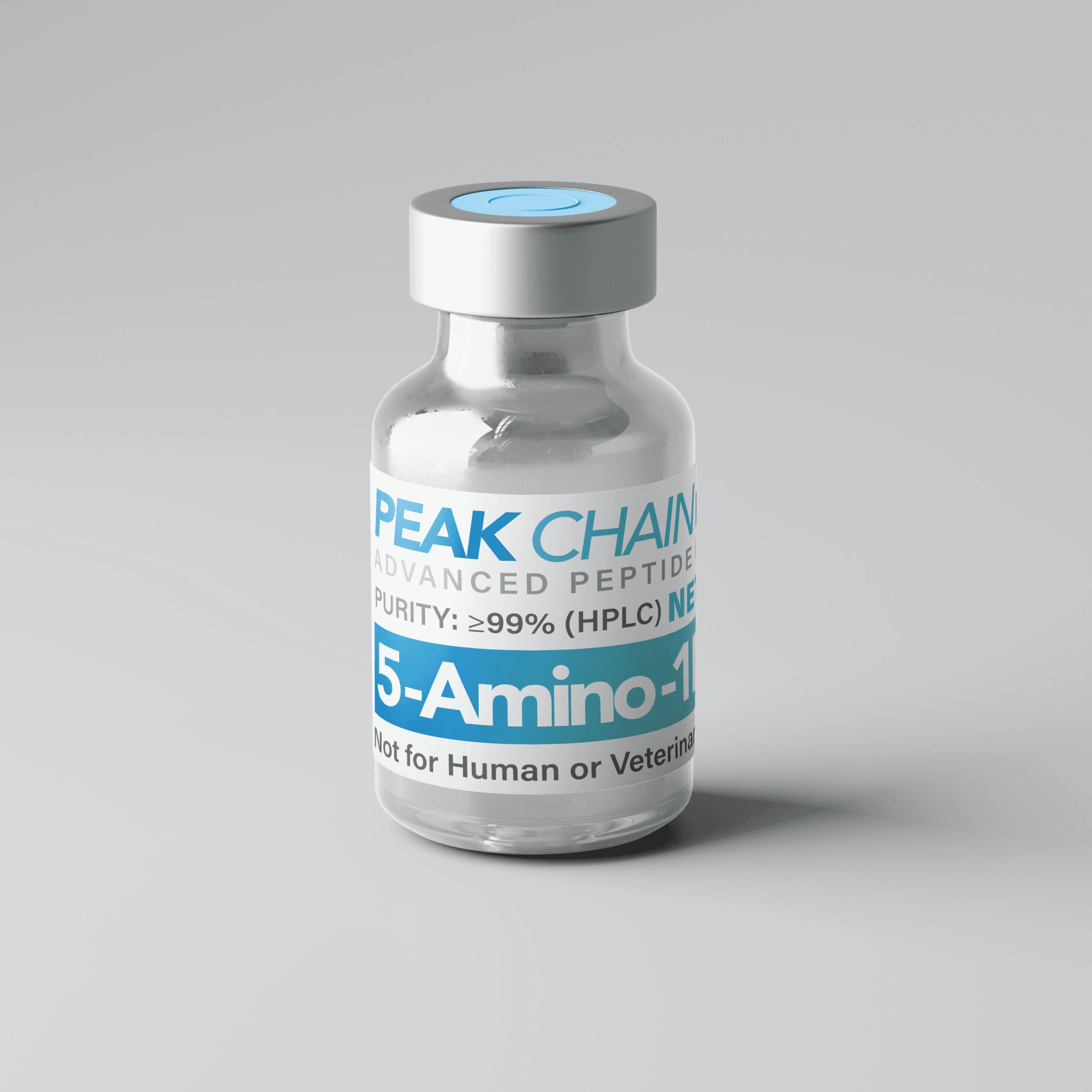
5-Amino-1MQ
Research Overview
What Is 5-Amino-1MQ?
5-Amino-1MQ (5-amino-1-methylquinolinium) is a small-molecule inhibitor of nicotinamide N-methyltransferase (NNMT). It is not a peptide. It was developed to selectively inhibit NNMT, an enzyme that links nicotinamide metabolism, NAD⁺ salvage pathways, and cellular methyl donor balance.
NNMT catalyzes the methylation of nicotinamide using S-adenosyl-L-methionine (SAM), producing 1-methylnicotinamide (1-MNA). Because this reaction consumes SAM and diverts nicotinamide from NAD⁺ salvage, NNMT influences:
- NAD⁺ homeostasis
- Cellular methylation demand
- Energy metabolism
- Metabolic–epigenetic coupling
A detailed biochemical review of NNMT structure, catalytic mechanism, and its integration into NAD⁺ and methylation networks is provided here:
https://pmc.ncbi.nlm.nih.gov/articles/PMC11196770/
This review explains the molecular basis for developing selective NNMT inhibitors such as 5-Amino-1MQ.
NNMT in Obesity & Metabolic Dysfunction
NNMT expression has been shown to increase in adipose tissue under obesity conditions. Elevated NNMT activity has been associated with altered lipid storage signaling and metabolic remodeling in adipocytes.
Experimental inhibition of NNMT, including work involving 5-Amino-1MQ, demonstrated reductions in fat mass and metabolic shifts in diet-induced obese (DIO) mouse models:
https://pmc.ncbi.nlm.nih.gov/articles/PMC5826726/
These findings provide mechanistic support for studying NNMT inhibition in metabolic research settings.
Discovery & Preclinical Validation of 5-Amino-1MQ
5-Amino-1MQ was identified through structure-guided medicinal chemistry efforts as a selective substrate-competitive inhibitor of NNMT.
The original study demonstrated:
- Direct inhibition of NNMT enzymatic activity
- Reduction in 1-MNA production
- Target engagement in cellular systems
- Reduced adiposity and weight gain in DIO mouse models
Neelakantan et al., Journal of Medicinal Chemistry, 2018
https://pmc.ncbi.nlm.nih.gov/articles/PMC5826726/
These findings are limited to preclinical laboratory research and animal models.
NNMT, Insulin Sensitivity & Metabolic Regulation
Independent metabolic research has demonstrated that elevated NNMT expression in adipose tissue is associated with impaired insulin sensitivity and altered energy expenditure.
Genetic suppression of NNMT in experimental models improved insulin sensitivity and metabolic parameters, reinforcing NNMT’s role in adipocyte metabolic regulation.
Kraus et al., Diabetologia, 2015
https://pubmed.ncbi.nlm.nih.gov/25596852/
This study did not evaluate 5-Amino-1MQ directly but establishes the enzyme’s connection to insulin resistance and metabolic dysfunction.
Diet-Induced Obesity & Microbiome Interaction
In addition to initial discovery work, 5-Amino-1MQ has been evaluated in DIO mouse models examining metabolic parameters alongside gut microbiome composition changes.
Dimet-Wiley et al., Scientific Reports, 2022
https://www.nature.com/articles/s41598-021-03670-5
This work further explores NNMT inhibition in preclinical obesity models.
Research Applications
Below are laboratory research applications with properly aligned supporting literature.
- Direct NNMT Enzyme Inhibition & Insulin Sensitivity Research
Used to study NNMT’s influence on insulin resistance, adipocyte metabolic programming, and energy expenditure pathways.
Supported by:
https://pubmed.ncbi.nlm.nih.gov/25596852/
- Obesity Modeling & Adiposity Regulation
Used in diet-induced obesity models to evaluate fat mass regulation, weight gain modulation, and adipose tissue metabolic signaling following NNMT inhibition.
Supported by:
https://pmc.ncbi.nlm.nih.gov/articles/PMC5826726/
- NAD⁺ Salvage & Methylation Coupling Studies
Used to investigate the biochemical relationship between NNMT activity, nicotinamide partitioning, and methyl donor utilization.
Supported by:
https://pmc.ncbi.nlm.nih.gov/articles/PMC11196770/
Simply Put
NNMT is an enzyme that affects how the body processes vitamin B3–related molecules and how cells regulate energy storage and methylation balance.
5-Amino-1MQ is a laboratory compound that blocks this enzyme so researchers can observe how metabolism shifts when NNMT activity is reduced.
It is a research tool used in controlled experimental models.
Scope of Published Evidence
Current evidence consists of:
- Enzyme inhibition studies
- Cellular metabolic experiments
- Diet-induced obese mouse models
- Mechanistic metabolic research
Human clinical trials evaluating 5-Amino-1MQ have not been published in peer-reviewed journals.
Compliance Statement
5-Amino-1MQ is intended strictly for laboratory research use.
Not for human consumption.
Not approved to diagnose, treat, cure, or prevent disease.
All information reflects published experimental data only.
Research Use Notice
All compounds are intended strictly for in vitro laboratory research use only. They are not intended for human or animal consumption, and no information on this page constitutes medical advice, diagnosis, or treatment.
By proceeding to purchase, you confirm that you are a qualified researcher purchasing for legitimate scientific research purposes in accordance with our Terms of Use.
You are here
Research Library
Mechanism of action, pathway data, and published literature — education first.
Next step
Product Catalog
Pricing, availability, and ordering — for qualified researchers only.
Ready to proceed?
If you have reviewed the available research and have a defined objective, you may proceed to the Product Catalog to view pricing and place an order.
Proceed to Product CatalogFor laboratory research use only · Qualified researchers only