
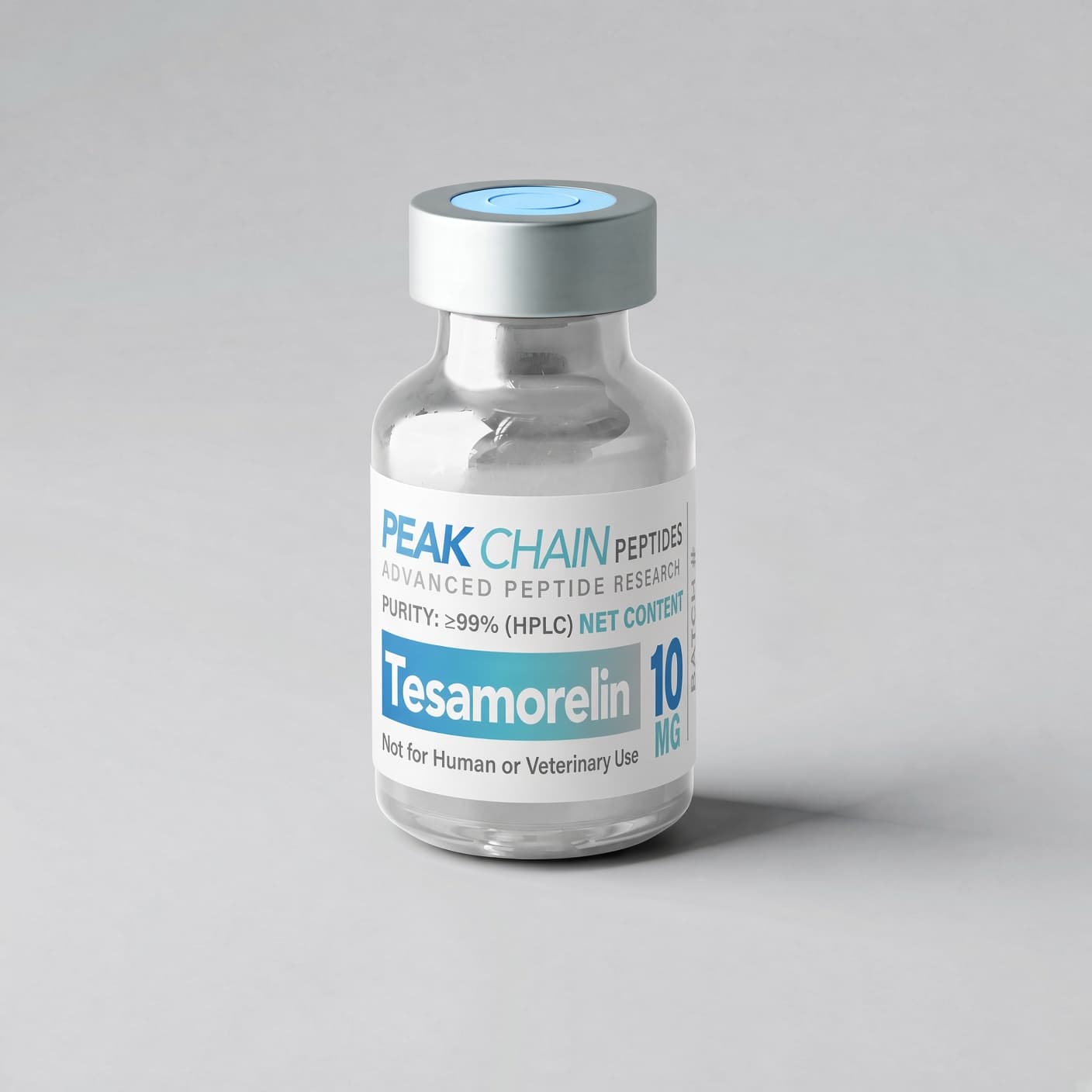
Tesamorelin 10mg
SKU: Tesa10-PC
TESAMORELIN
Overview
Tesamorelin is a synthetic analog of human growth hormone-releasing hormone (GHRH), also referred to as growth hormone-releasing factor (GHRF). It consists of the 44-amino-acid sequence of human GHRH with a structural modification designed to increase resistance to enzymatic degradation while preserving biological activity.
Tesamorelin acts primarily through the GHRH receptor in the anterior pituitary, stimulating endogenous growth hormone (GH) secretion. Increased GH signaling subsequently promotes production of insulin-like growth factor-1 (IGF-1) and influences metabolic pathways involved in lipid utilization, body composition, adipose-tissue distribution, and other GH-responsive physiological processes.
Unlike direct administration of growth hormone, tesamorelin stimulates the body’s existing hypothalamic-pituitary growth hormone axis. This distinction has made tesamorelin particularly valuable in research examining the relationship between GHRH signaling, endogenous GH secretion, IGF-1, visceral adiposity, lipid metabolism, hepatic fat, and metabolic function.
Tesamorelin is unusual among peptides commonly discussed in the research market because it has undergone extensive controlled human investigation and has an FDA-approved pharmaceutical form for a specific medical indication. FDA-approved tesamorelin is indicated for the reduction of excess abdominal fat in adults with HIV and lipodystrophy; importantly, FDA labeling specifically states that it is not indicated for weight-loss management.
Mechanism of Action
Tesamorelin binds to and activates GHRH receptors located on pituitary somatotroph cells. Activation of these receptors stimulates synthesis and pulsatile secretion of endogenous growth hormone.
The resulting signaling pathway can be summarized as:
Tesamorelin → GHRH receptor activation → increased endogenous GH secretion → increased IGF-1 signaling → downstream metabolic and tissue effects
This mechanism distinguishes tesamorelin from growth hormone secretagogues such as ipamorelin, which primarily act through the growth hormone secretagogue receptor (GHSR-1a), commonly called the ghrelin receptor.
Although both pathways can ultimately increase GH secretion, they accomplish this through different receptor systems. Tesamorelin therefore provides researchers with a means of investigating the GHRH-dependent component of the GH/IGF-1 axis.
Visceral Adipose Tissue Research
One of the most extensively investigated properties of tesamorelin is its effect on visceral adipose tissue (VAT).
Visceral fat differs metabolically from subcutaneous fat. It surrounds internal abdominal organs and is strongly associated with metabolic signaling, lipid abnormalities, insulin resistance, inflammation, and cardiovascular risk.
Controlled human studies of tesamorelin have demonstrated significant reductions in visceral adipose tissue, with comparatively limited effects on subcutaneous adipose tissue. This suggests that its influence on body composition is not simply generalized weight reduction.
In a randomized controlled trial involving 404 adults with HIV-associated abdominal fat accumulation, visceral adipose tissue decreased by 10.9% after six months in the tesamorelin group compared with 0.6% in the placebo group. Among participants continuing treatment for 12 months, VAT was reduced by approximately 18%.
Earlier randomized research involving 412 participants similarly demonstrated significant reductions in visceral adipose tissue together with changes in triglycerides and other metabolic measurements.
These findings established visceral adipose tissue as one of the principal areas of tesamorelin research.
Lipid and Metabolic Research
The GH/IGF-1 axis participates extensively in lipid metabolism. Growth hormone promotes lipolysis, influencing the mobilization and utilization of stored triglycerides within adipose tissue.
Tesamorelin research has consequently examined changes in triglycerides, cholesterol measurements, inflammatory markers, glucose regulation, and other metabolic variables alongside changes in visceral fat.
A randomized controlled study in abdominally obese individuals with reduced GH secretion found that tesamorelin selectively reduced visceral adipose tissue while producing significant changes in triglycerides, C-reactive protein and carotid intima-media thickness. Importantly, the study population differed from the HIV-lipodystrophy population underlying tesamorelin’s approved indication, so these findings represent investigational research rather than an established therapeutic use.
Additional analyses of Phase III data have examined whether individuals demonstrating greater reductions in visceral adipose tissue also exhibit corresponding improvements in metabolic measurements.
Hepatic Fat Research
Tesamorelin has also become an important investigational compound in research involving hepatic fat accumulation.
A randomized clinical trial published in JAMA investigated both visceral and hepatic fat in adults with HIV-associated abdominal adiposity. Researchers observed significant reductions in visceral adipose tissue and a modest but statistically significant reduction in liver fat compared with placebo.
A subsequent randomized, double-blind multicenter trial specifically examined tesamorelin in individuals with HIV and nonalcoholic fatty liver disease. After 12 months, the tesamorelin group demonstrated an approximately 37% relative reduction in hepatic fat fraction from baseline compared with placebo, and a greater proportion of participants reached hepatic fat levels below the study’s threshold for steatosis.
These findings have expanded scientific interest in GHRH/GH signaling beyond visceral adipose tissue and into the relationship between growth hormone physiology, ectopic lipid accumulation and hepatic metabolism.
They should not, however, be interpreted as establishing tesamorelin as an approved treatment for fatty liver disease in the general population.
Adipose Tissue Quality
Research has also investigated whether tesamorelin influences the biological characteristics of adipose tissue in addition to reducing its quantity.
A secondary analysis involving participants from placebo-controlled tesamorelin trials examined adipose-tissue density using computed tomography. Among individuals who demonstrated a visceral-fat response to tesamorelin, researchers observed changes in both visceral and subcutaneous adipose-tissue density.
These findings suggest that GHRH/GH-axis manipulation may influence measurable characteristics of adipose tissue beyond simply changing the amount of stored fat.
GH and IGF-1 Research
Because tesamorelin stimulates endogenous GH secretion, increased IGF-1 represents an expected downstream biological response.
IGF-1 is involved in numerous physiological processes, including protein metabolism, tissue remodeling, cellular signaling, glucose and lipid metabolism, and maintenance of multiple tissues.
This makes tesamorelin scientifically relevant beyond body-composition research. However, activation of the GH/IGF-1 axis also creates important safety considerations because excessive or prolonged IGF-1 signaling is not inherently beneficial.
Tesamorelin should therefore be understood as a neuroendocrine signaling peptide, rather than simply being categorized as a “fat-loss peptide.”
Duration and Reversibility of Effects
Long-term extension research provides an important insight into tesamorelin’s biological activity.
Participants who continued tesamorelin maintained reductions in visceral adipose tissue over 52 weeks, while participants switched from tesamorelin to placebo experienced reaccumulation of visceral fat.
This indicates that the observed effects are related to continued modification of the GHRH/GH metabolic environment rather than a permanent alteration in adipose-tissue physiology.
Additional Areas of Research
Because GHRH receptors and the GH/IGF-1 axis participate in broader physiological processes, tesamorelin has also been investigated outside its established visceral-fat research.
One controlled trial studied tesamorelin in healthy older adults and adults with mild cognitive impairment, examining executive function, verbal memory, visual memory, body composition, IGF-1 and metabolic measurements. The investigators reported favorable effects on an overall cognitive measure and executive function during the 20-week study while emphasizing the need for longer-duration research.
This represents an investigational area and should not be interpreted as evidence that tesamorelin is an established treatment for cognitive impairment or neurodegenerative disease.
Research Considerations
Because tesamorelin directly influences the GH/IGF-1 endocrine axis, research involving the compound requires consideration of physiological systems affected by increased growth-hormone signaling.
FDA prescribing information for pharmaceutical tesamorelin identifies considerations including elevated IGF-1, glucose intolerance or diabetes, fluid retention, hypersensitivity reactions, injection-site reactions, and contraindications related to disruption of the hypothalamic-pituitary axis and active malignancy. Long-term cardiovascular safety has not been established.
These considerations are particularly important when distinguishing tesamorelin from peptides whose primary mechanisms do not involve systemic growth-factor signaling.
Research Significance
Tesamorelin represents one of the more extensively characterized peptides within the GHRH/GH research category.
Its scientific importance stems from its ability to stimulate endogenous growth hormone secretion through the GHRH receptor, producing downstream changes in IGF-1 and metabolic signaling while retaining physiological regulation of the GH axis.
Human research has established measurable biological effects involving visceral adipose tissue, lipid metabolism, body composition and GH/IGF-1 signaling, while additional investigations have explored hepatic fat, adipose-tissue characteristics and other metabolic and neuroendocrine applications.
For research purposes, tesamorelin is therefore best characterized as a GHRH analog and GH-axis research peptide, rather than simply as a weight-management or body-composition compound.
Verified Scientific Research
Each publication below is a different study or research analysis, and I verified that the PubMed record corresponds to the title and tesamorelin research described above.
- Metabolic Effects of a Growth Hormone-Releasing Factor in Patients with HIV — New England Journal of Medicine, 2007. Randomized controlled trial of 412 participants examining visceral adipose tissue and metabolic outcomes.
PubMed — PMID 18057338 - Long-term Safety and Effects of Tesamorelin, a Growth Hormone-Releasing Factor Analogue, in HIV Patients with Abdominal Fat Accumulation — 52-week extension examining durability of VAT reduction and effects after discontinuation.
PubMed — PMID 18690162 - Effects of Tesamorelin on HIV-Infected Patients with Abdominal Fat Accumulation: A Randomized Placebo-Controlled Trial with a Safety Extension — 12-month randomized study involving 404 participants.
PubMed — PMID 20101189 - Reduction in Visceral Adiposity Is Associated with an Improved Metabolic Profile in HIV-Infected Patients Receiving Tesamorelin — analysis examining relationships between VAT response and metabolic measurements.
PubMed — PMID 22495074 - Metabolic Effects of a Growth Hormone-Releasing Factor in Obese Subjects with Reduced Growth Hormone Secretion: A Randomized Controlled Trial — investigation of VAT and cardiometabolic measurements outside the HIV-associated lipodystrophy population.
PubMed — PMID 23015655 - Effect of Tesamorelin on Visceral Fat and Liver Fat in HIV-Infected Patients with Abdominal Fat Accumulation: A Randomized Clinical Trial — JAMA, 2014.
PubMed — PMID 25038357 - Effects of Tesamorelin on Non-Alcoholic Fatty Liver Disease in HIV: A Randomised, Double-Blind, Multicentre Trial — The Lancet HIV, 2019.
PubMed — PMID 31611038 - Tesamorelin Improves Fat Quality Independent of Changes in Fat Quantity — research examining CT-derived adipose-tissue density.
PubMed — PMID 33756511 - Effects of Growth Hormone-Releasing Hormone on Cognitive Function in Adults With Mild Cognitive Impairment and Healthy Older Adults: Results of a Controlled Trial — 20-week tesamorelin study investigating cognition, IGF-1 and body composition.
PubMed — PMID 22869065
Research Use Disclaimer
Tesamorelin sold as a research material is intended for laboratory and research purposes only and should not be represented as an FDA-approved pharmaceutical product. FDA approval applies to specific prescription tesamorelin products and their approved indication; it does not extend to independently manufactured research-grade tesamorelin. Research findings discussed above describe published scientific investigations and should not be interpreted as claims that a research product diagnoses, treats, cures, or prevents disease.
| SKU | Tesa10-PC |
|---|
Certificate of Analysis
Independent third-party analytical testing is performed on every production batch. The document to the left contains all testing results for the batch corresponding to this product.
Opens / saves as PDF document