
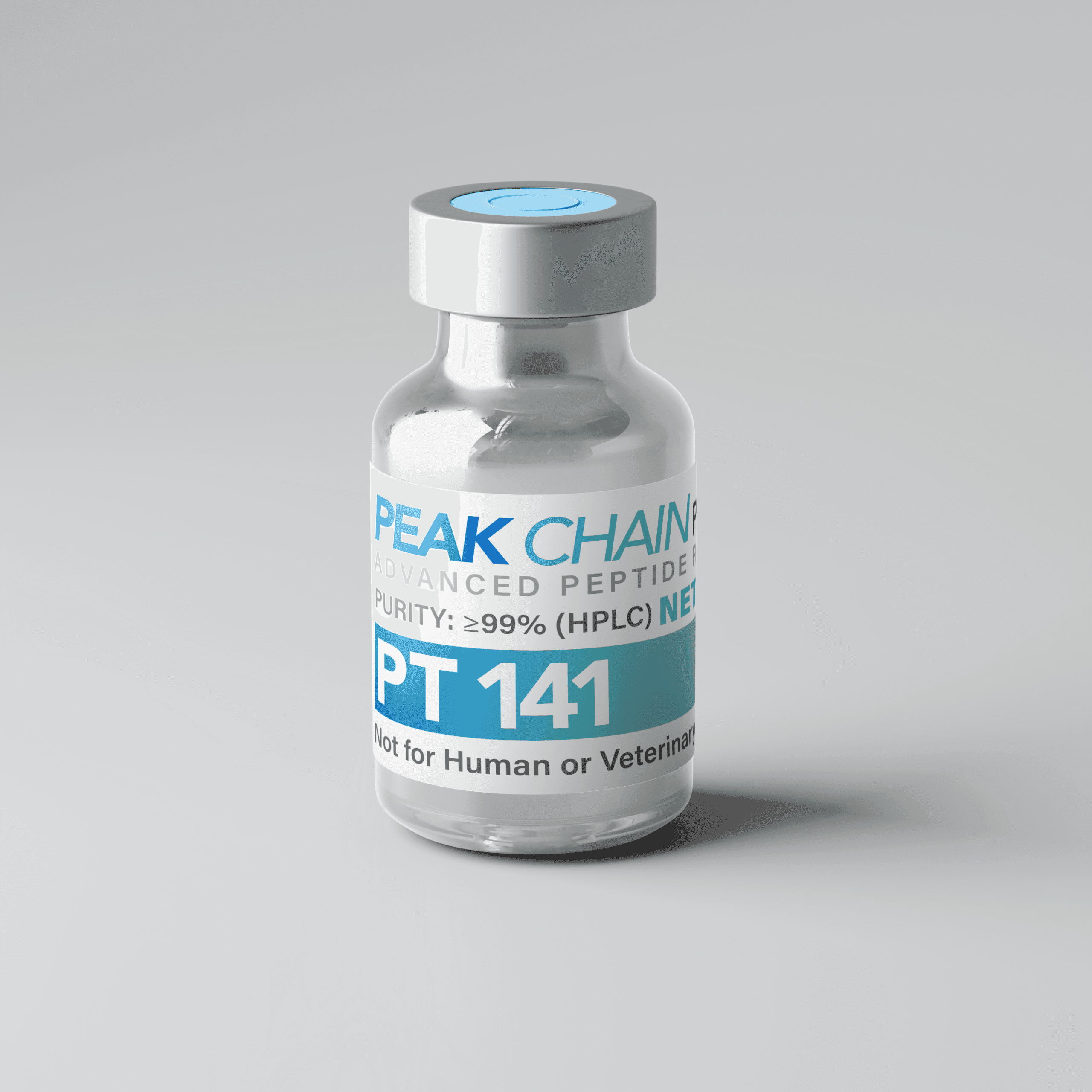
PT-141 (Bremelanotide)
SKU: P41-PC
What Is PT-141?
PT-141, also known as bremelanotide, is a synthetic peptide and melanocortin receptor agonist derived from melanotan II. It was specifically engineered to selectively activate melanocortin receptors involved in central nervous system regulation of sexual desire and arousal, rather than targeting peripheral vascular mechanisms.
Pharmacologic development and early investigational positioning of PT-141 as a centrally acting melanocortin compound were described during its early clinical development phase.
https://pubmed.ncbi.nlm.nih.gov/15134289/
PT-141 primarily activates the melanocortin-4 receptor (MC4R), a G-protein–coupled receptor located in the hypothalamus and limbic brain regions. These regions regulate:
- Motivation
- Reward processing
- Emotional drive
- Autonomic nervous system signaling
- Sexual behavior
Unlike phosphodiesterase-5 (PDE-5) inhibitors, PT-141 does not function by increasing nitric oxide or enhancing penile blood flow. Instead, it acts at the level of central arousal signaling pathways.
Mechanism of Action (Scientific Explanation)
Activation of MC4R receptors influences:
- Dopaminergic reward pathways
- Hypothalamic neuropeptide signaling
- Autonomic output
- Behavioral motivation circuits
The melanocortin system’s role in sexual physiology and its central integration within neuroendocrine networks is discussed in detail in a sexual medicine systems review.
https://pubmed.ncbi.nlm.nih.gov/35428435/
Foundational mechanistic work demonstrated that melanocortin receptor agonists can induce erectile responses through central neural pathways independent of peripheral vasodilation.
https://pubmed.ncbi.nlm.nih.gov/12851303/
Simply Put
PT-141 works by activating specific receptors in the brain that influence desire and motivation. It does not “increase circulation.” Instead, it activates the brain circuits that initiate interest.
Female Sexual Dysfunction Research (Premenopausal Focus)
Hypoactive Sexual Desire Disorder (HSDD)
PT-141 was extensively studied in acquired, generalized hypoactive sexual desire disorder (HSDD) in premenopausal women.
HSDD is associated with imbalance between:
- Excitatory neurotransmitters (dopamine, norepinephrine)
- Inhibitory pathways (serotonin)
- Central melanocortin signaling
MC4R activation provides a mechanism for enhancing excitatory arousal pathways within the hypothalamus.
The role of melanocortin receptors in female sexual desire regulation is detailed in the sexual medicine review.
https://pubmed.ncbi.nlm.nih.gov/35428435/
Phase III Clinical Trials in Premenopausal Women
Large randomized trials evaluated bremelanotide in premenopausal women with acquired, generalized HSDD.
Primary findings included:
- Statistically significant improvements in sexual desire scores
- Reduction in distress related to low desire
- Increased satisfying sexual events
These findings and regulatory review were summarized in the global approval publication.
https://pubmed.ncbi.nlm.nih.gov/31429064/
A comprehensive pharmacotherapy review further evaluated efficacy outcomes, pharmacokinetics, and benefit-risk considerations.
https://pubmed.ncbi.nlm.nih.gov/38767282/
A gynecologic review focused specifically on bremelanotide in HSDD provides additional analysis of safety and clinical positioning.
https://pubmed.ncbi.nlm.nih.gov/?term=10.23736%2FS2724-606X.22.04966-1
An updated gynecologic review continues to evaluate bremelanotide within female sexual medicine practice.
https://pubmed.ncbi.nlm.nih.gov/40543759/
Safety Profile in Women
Across Phase II and III trials:
- Rapid absorption following subcutaneous administration
- Short plasma half-life
- Dose-dependent nausea
- Flushing
- Transient increases in blood pressure
Safety and tolerability findings are summarized in the approval review and pharmacotherapy update.
https://pubmed.ncbi.nlm.nih.gov/31429064/
https://pubmed.ncbi.nlm.nih.gov/38767282/
An expert pharmacology review provides additional post-approval evaluation of receptor pharmacodynamics and safety observations.
https://pubmed.ncbi.nlm.nih.gov/?term=10.1080%2F14656566.2025.2478912
Simply Put
In women, PT-141 was studied to gently stimulate the brain’s motivation pathways rather than changing hormones or increasing blood flow. Most side effects were temporary and dose-related.
Male Sexual Dysfunction Research
Although PT-141 ultimately received approval for HSDD in premenopausal women, its early development included research in men with erectile dysfunction.
Controlled human studies demonstrated:
- Dose-dependent erectile responses
- Activity in psychogenic and mixed etiologies
- Central mechanism independent of nitric oxide pathways
https://pubmed.ncbi.nlm.nih.gov/14999221/
Developmental pharmacology summaries further described its central melanocortin mechanism and differentiation from vascular agents.
https://pubmed.ncbi.nlm.nih.gov/15134289/
These studies confirmed that melanocortin receptor activation alone can initiate arousal responses through central nervous system signaling.
Simply Put
In men, PT-141 showed that erections can be initiated by activating brain receptors—even without directly affecting blood vessels.
Neuroendocrine & Central Integration
Melanocortin receptor signaling interacts with:
- Dopamine-mediated reward pathways
- Hypothalamic control of behavior
- Autonomic nervous system tone
- Motivational circuitry
The melanocortin system’s integration within sexual medicine is discussed in detail in:
https://pubmed.ncbi.nlm.nih.gov/35428435/
This central mechanism explains why PT-141’s activity is considered neurologically mediated rather than vascularly mediated.
Additional Scientific Research Publications
Foundational central melanocortin erection research
https://pubmed.ncbi.nlm.nih.gov/12851303/
Early human male clinical trial
https://pubmed.ncbi.nlm.nih.gov/14999221/
Investigational pharmacology review
https://pubmed.ncbi.nlm.nih.gov/15134289/
Global approval summary
https://pubmed.ncbi.nlm.nih.gov/31429064/
Melanocortin system in sexual medicine
https://pubmed.ncbi.nlm.nih.gov/35428435/
Gynecologic HSDD review
https://pubmed.ncbi.nlm.nih.gov/?term=10.23736%2FS2724-606X.22.04966-1
Comprehensive pharmacotherapy review
https://pubmed.ncbi.nlm.nih.gov/38767282/
Expert pharmacology update
https://pubmed.ncbi.nlm.nih.gov/?term=10.1080%2F14656566.2025.2478912
Updated gynecologic perspective
https://pubmed.ncbi.nlm.nih.gov/40543759/
Compliance Statement
PT-141 (Bremelanotide) is supplied for research use only. It is not intended for diagnostic or therapeutic application outside of approved regulatory contexts. Information provided here is for scientific and educational purposes.
| SKU | P41-PC |
|---|
Certificate of Analysis
Independent third-party analytical testing is performed on every production batch. The document to the left contains all testing results for the batch corresponding to this product.
Opens / saves as PDF document