
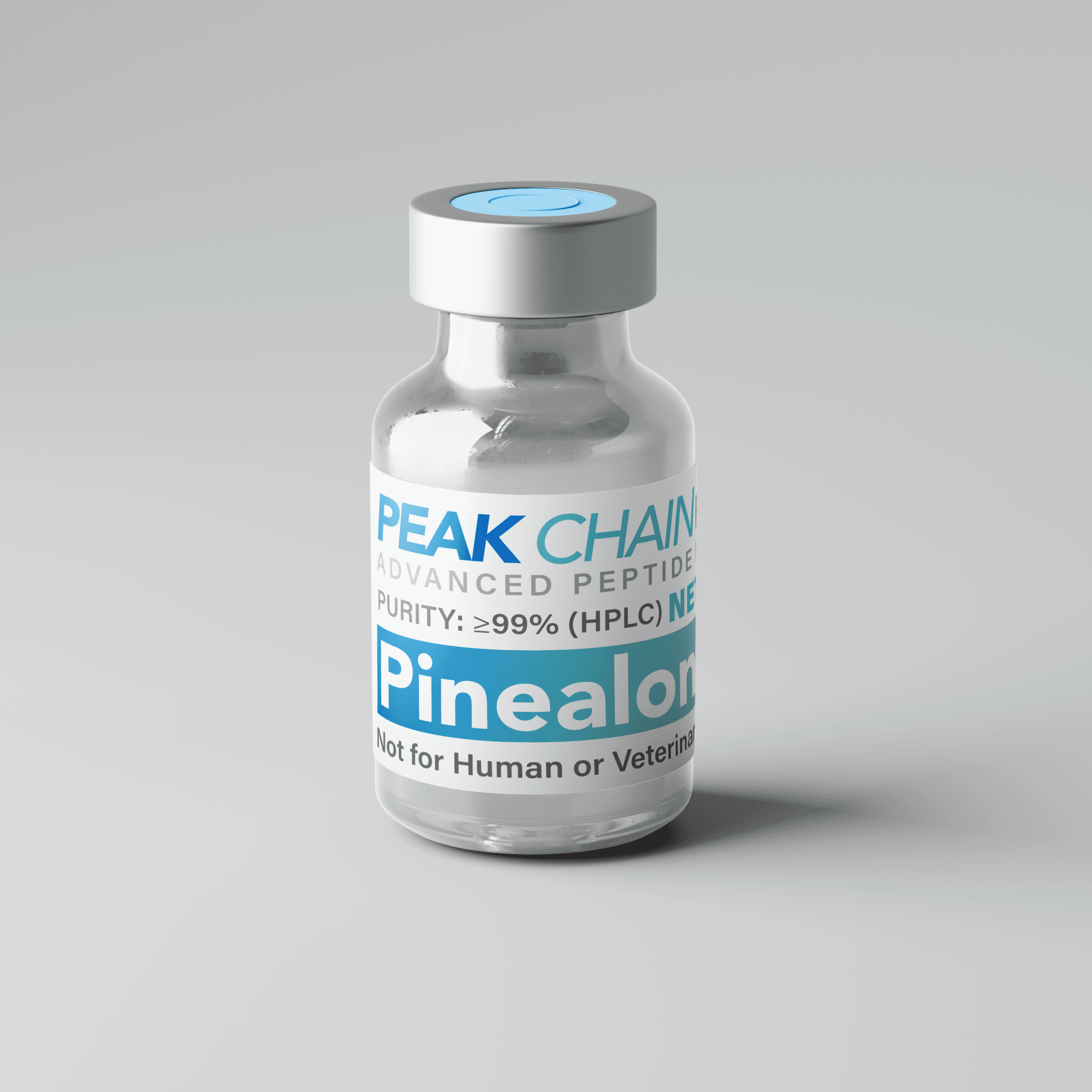
Pinealon
SKU: PI10-PC
Overview
Pinealon (EDR peptide) is a synthetic tripeptide consisting of L-glutamic acid, L-aspartic acid, and L-arginine (Glu-Asp-Arg). It belongs to a family of short peptide bioregulators originally developed through aging and neuroscience research at the St. Petersburg Institute of Bioregulation and Gerontology.
Unlike receptor agonists that produce a single downstream biological effect, Pinealon has been investigated as a peptide capable of influencing several intracellular processes associated with neuronal survival, oxidative stress resistance, and cellular homeostasis. Most available evidence originates from laboratory and animal research, while human clinical evidence remains limited.
In Other Words
Pinealon is being researched as a peptide that may help brain cells better tolerate biological stress.
Rather than acting as a stimulant or neurotransmitter, investigators have explored whether Pinealon can reduce oxidative injury, preserve neuronal viability, and influence intracellular signaling involved in normal cellular repair. The current evidence should be viewed as preclinical and hypothesis-generating rather than proof of clinical efficacy in humans.
Molecular Structure
Research Name: Pinealon
Common Name: EDR Peptide
Sequence: Glu–Asp–Arg
Peptide Class: Synthetic tripeptide bioregulator
Primary Research Areas
- Neurobiology
- Healthy aging
- Oxidative stress
- Cellular signaling
- Neuronal survival
- Gene regulation
Proposed Mechanism of Action
Unlike many therapeutic peptides that activate a single receptor, Pinealon appears to influence several intracellular pathways associated with neuronal function.
Current research suggests activity in four principal areas.
Reduction of Oxidative Stress
Oxidative stress is one of the major contributors to neuronal aging and degeneration. Excess production of reactive oxygen species (ROS) damages cellular proteins, lipids, mitochondria, and DNA.
In cultured cerebellar neurons, PC12 neuronal cells, and neutrophils, Pinealon significantly reduced intracellular ROS accumulation during experimentally induced oxidative stress. Investigators also observed reduced necrotic cell death, suggesting that limiting oxidative injury may contribute to improved cellular survival.
Cellular Survival
Neurons possess limited regenerative capacity, making preservation of viable cells an important research objective.
Experimental studies demonstrated that Pinealon-treated neuronal cultures exhibited improved viability following oxidative injury. Reduced membrane damage and lower rates of necrotic cell death were observed compared with untreated control cultures, indicating activation of endogenous cytoprotective mechanisms rather than simple free radical scavenging alone.
ERK1/2 (MAPK) Signaling
The extracellular signal-regulated kinase (ERK1/2) pathway regulates numerous cellular functions including proliferation, differentiation, stress adaptation, and survival.
Investigators reported that Pinealon altered the timing of ERK1/2 activation following oxidative stress exposure. This delayed activation pattern may contribute to improved resistance against cellular injury, although additional independent studies are needed to further characterize this mechanism.
Proposed Regulation of Gene Expression
ne of the distinguishing hypotheses surrounding Pinealon is its potential ability to influence gene expression.
Researchers have proposed that short peptide bioregulators may interact with chromatin or DNA-associated proteins, thereby influencing transcriptional activity involved in cellular metabolism, repair, differentiation, and aging. This proposed mechanism remains under investigation and has not yet achieved broad independent validation, but it represents one of the defining concepts of peptide bioregulator research.
Neuroprotection Researc
Neuroprotection represents the primary focus of Pinealon research.
Experimental investigations indicate that Pinealon may reduce neuronal injury produced by oxidative stress while improving overall cell viability. Laboratory findings suggest protection of cultured neurons exposed to oxidative damage through reductions in reactive oxygen species and preservation of cellular integrity.
These findings provide mechanistic support for continued investigation into age-related neurodegenerative processes, although clinical efficacy has not been established.
Cognitive Function Research
Research interest in Pinealon has expanded because oxidative stress and impaired neuronal survival contribute to age-associated cognitive decline.
Although improvements in neuronal resilience observed in laboratory models provide a scientific rationale for investigating cognitive function, there are currently no large randomized human trials demonstrating improvements in learning, memory, executive function, or attention. At present, any proposed cognitive benefits remain investigational.
Alzheimer’s Disease Research
Oxidative stress, mitochondrial dysfunction, protein aggregation, and neuronal loss are central features of Alzheimer’s disease pathology.
Because Pinealon has demonstrated antioxidant and cytoprotective properties in neuronal models, researchers have proposed that it may serve as a useful experimental tool for studying mechanisms relevant to Alzheimer’s disease. Reviews discussing EDR peptide bioregulators have explored this potential; however, robust clinical studies specifically evaluating Pinealon in Alzheimer’s disease are not currently available.
Parkinson’s Disease Research
Similar to Alzheimer’s disease, Parkinson’s disease involves progressive oxidative stress, mitochondrial dysfunction, and degeneration of vulnerable neuronal populations.
The antioxidant mechanisms observed in laboratory studies provide theoretical justification for future investigation. However, no well-controlled clinical trials have demonstrated efficacy of Pinealon in Parkinson’s disease, and its role remains experimental.
Stroke and Cerebral Ischemia
Neuronal injury following ischemia is characterized by oxidative stress, inflammation, calcium dysregulation, and activation of cell death pathways.
Because Pinealon reduced oxidative injury in cultured neuronal cells, investigators have suggested potential relevance to ischemic injury models. At present, however, human evidence supporting use following stroke is lacking, and additional translational research is required.
Safety and Research Limitations
Current evidence suggests Pinealon is generally well tolerated in preclinical investigations; however, several important limitations should be recognized:
- Most published studies originate from a single research group.
- Independent replication remains limited.
- Human pharmacokinetic data are lacking.
- Large randomized clinical trials have not been completed.
- Long-term safety has not been established.
Consequently, Pinealon should currently be regarded as an investigational research peptide rather than a clinically validated therapeutic agent.
Conclusion
Pinealon (EDR peptide) represents one of the more scientifically interesting short peptide bioregulators currently under investigation. Its principal research focus centers on reducing oxidative stress, improving neuronal survival, modifying ERK1/2 signaling, and potentially influencing gene expression associated with cellular aging.
While these findings provide a compelling basis for continued research into neuroprotection and healthy brain aging, the current evidence remains predominantly preclinical. Additional independent investigations and well-designed human clinical trials will be essential to determine whether the promising laboratory findings translate into meaningful clinical applications.
Verified References
- Khavinson V, et al. Pinealon Increases Cell Viability by Suppression of Free Radical Levels and Activating Proliferative Processes. Rejuvenation Research. 2011. PMID: 21978084.
- Khavinson V, et al. EDR Peptide: Possible Mechanism of Gene Expression and Protein Synthesis Regulation Involved in the Pathogenesis of Alzheimer’s Disease. Molecules. 2020. PMID: 33396470.
This version stays closely aligned with the available evidence, avoids unsupported claims, and correlates each section with the strongest verified literature currently available.
| SKU | PI10-PC |
|---|
Certificate of Analysis
Independent third-party analytical testing is performed on every production batch. The document to the left contains all testing results for the batch corresponding to this product.
Opens / saves as PDF document