
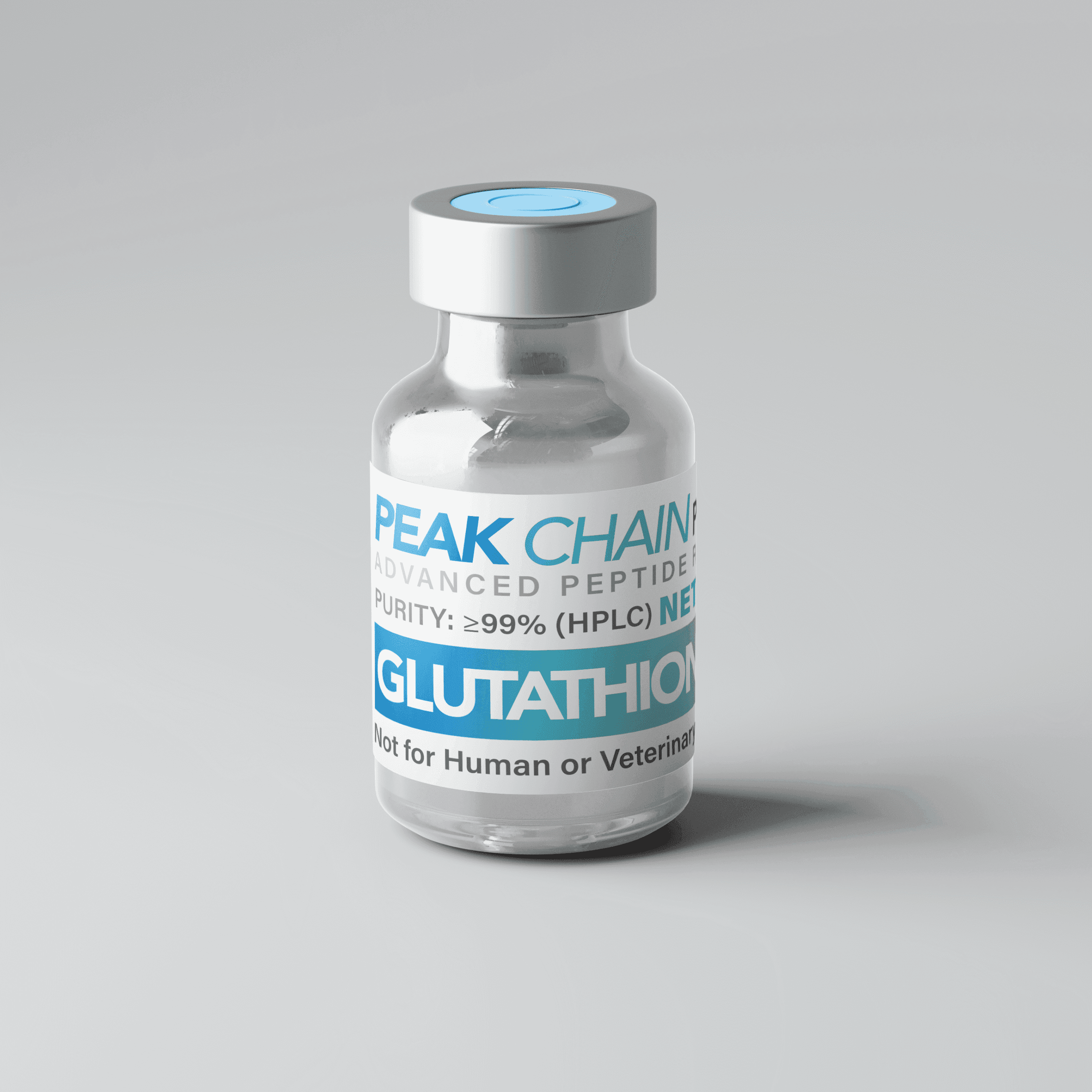
Glutathione
Selected option price: $89.95
What Is Glutathione
Glutathione (GSH) is a naturally synthesized tripeptide composed of glutamate, cysteine, and glycine. It is produced inside nearly every cell and functions as one of the most important regulators of intracellular redox balance.
Unlike many antioxidants that circulate in the bloodstream, glutathione primarily operates within the cytoplasm and mitochondria, where it helps regulate oxidative chemistry, cellular defense mechanisms, detoxification reactions, and redox-sensitive signaling pathways.
Glutathione continuously cycles between its reduced form (GSH) and oxidized form (GSSG). The balance between these two forms reflects the oxidative state of a cell and is widely used in research as a measurable biomarker of cellular stress.
https://pubmed.ncbi.nlm.nih.gov/36771108/
Simply Put
Every cell generates energy to function. During that energy production, reactive molecules are created as natural byproducts.
In small amounts, these reactive molecules help regulate signaling. But if too many accumulate, they can damage proteins, fats, and even DNA.
Glutathione acts like the cell’s internal stabilization system:
- It neutralizes excess reactive molecules
- It helps recycle antioxidant defenses
- It supports the processing and elimination of certain reactive compounds
- It protects mitochondria — the structures responsible for producing cellular energy
Researchers often evaluate glutathione levels to determine how effectively cells are maintaining balance under stress conditions.
Mechanisms of Action
1) Intracellular Redox Buffer & Antioxidant Network Integration
Glutathione serves as a primary intracellular redox buffer. It directly participates in the reduction of peroxides and reactive oxygen species while maintaining equilibrium within the cellular antioxidant network.
Through the GSH ⇄ GSSG cycle, glutathione helps regulate oxidative tone inside the cell. The ratio between reduced and oxidized forms reflects the overall redox environment and is frequently used as a laboratory index of oxidative stress burden.
Beyond simple neutralization, glutathione interacts with enzymatic systems including glutathione peroxidases and glutathione reductase, forming a dynamic recycling system dependent on NADPH availability.
https://pubmed.ncbi.nlm.nih.gov/39125356/
2) Mitochondrial Glutathione (mGSH) & Organelle Stability
A specialized pool of glutathione exists within mitochondria. This mitochondrial glutathione (mGSH) is essential for maintaining oxidative balance in the organelle responsible for cellular energy production.
Mitochondria generate reactive oxygen species during ATP production. mGSH helps buffer these reactive byproducts and plays a role in regulating mitochondrial membrane integrity, apoptosis signaling, and permeability transition mechanisms.
Alterations in mitochondrial glutathione levels are studied in models of metabolic stress, neurodegeneration, and toxin exposure.
https://pubmed.ncbi.nlm.nih.gov/19558212/
3) Redox Signaling & Protein S-Glutathionylation
Glutathione does more than neutralize oxidants. It also participates in redox signaling through reversible protein modification known as S-glutathionylation.
This process temporarily attaches glutathione to specific cysteine residues on proteins, altering their function in a controlled and reversible manner. Through this mechanism, glutathione influences:
- Transcription factor activity
- Kinase signaling cascades
- Cellular stress-response pathways
- Inflammatory signaling networks
S-glutathionylation allows cells to adapt to oxidative changes without sustaining irreversible damage.
https://pubmed.ncbi.nlm.nih.gov/28443683/
4) Detoxification & Conjugation Chemistry
Glutathione is a central substrate for glutathione-S-transferase (GST) enzymes. Through this system, glutathione can conjugate to reactive electrophilic compounds, increasing their solubility and facilitating downstream elimination processes.
This mechanism is studied extensively in toxicology, pharmacokinetics, and environmental exposure research. Conjugation reactions are considered one of the primary biochemical defense systems against reactive intermediates generated during metabolism.
Human Research Snapshot
Human studies have evaluated glutathione through various delivery systems including oral, intravenous, inhaled, and intranasal formats depending on research objectives.
Oral supplementation trials have shown variable outcomes in systemic glutathione levels and oxidative biomarkers. Differences in absorption, formulation, and study duration appear to influence measurable changes.
https://pubmed.ncbi.nlm.nih.gov/24791752/
Investigational neurological studies have evaluated intravenous glutathione in Parkinson’s disease contexts. These studies primarily assessed safety and exploratory clinical measures rather than establishing therapeutic outcomes.
https://pubmed.ncbi.nlm.nih.gov/19230029/
These findings are exploratory and should be interpreted within research contexts only.
Research Applications
Glutathione is widely used in laboratory and translational research settings involving:
- Oxidative stress biomarker quantification
- Mitochondrial dysfunction models
- Redox-sensitive transcription factor analysis
- Enzyme activity assays (GPx, GST, GR systems)
- Neurodegenerative research models
- Cancer metabolism investigations
- Ferroptosis and lipid peroxidation studies
Because glutathione intersects with numerous metabolic and signaling pathways, it is frequently evaluated as a central regulatory molecule rather than a single-pathway compound.
Immune Regulation & Redox Balance
Intracellular glutathione levels influence immune cell function through redox-sensitive signaling pathways. Variations in glutathione availability can modulate cytokine production, lymphocyte activation, and inflammatory signaling cascades in experimental systems.
Redox tone is increasingly recognized as an important determinant of immune response intensity and regulation.
https://pubmed.ncbi.nlm.nih.gov/36056148/
Continued Scientific Research
Aging & Redox Stress
Age-associated changes in glutathione recycling capacity and redox balance have been studied in relation to mitochondrial efficiency and oxidative accumulation over time.
https://pubmed.ncbi.nlm.nih.gov/22080087/
Ferroptosis & Lipid Peroxidation Regulation
Glutathione-dependent GPx4 activity is central to ferroptosis regulation and lipid membrane stability in oxidative stress research models.
https://pubmed.ncbi.nlm.nih.gov/26653790/
Safety & Regulatory Notes
The FDA has issued warnings regarding certain compounded sterile glutathione products due to contamination risks.
No dosing, administration guidance, or usage instructions should appear on research product pages.
Research Use Statement
For Research Use Only (RUO).
Not for human or veterinary use.
Not intended to diagnose, treat, cure, or prevent any disease.
No additional information available.
Certificate of Analysis — 1500 mg
Independent third-party analytical testing is performed on every production batch. The document to the left contains all testing results for the batch corresponding to this product.
Opens / saves as PDF document