
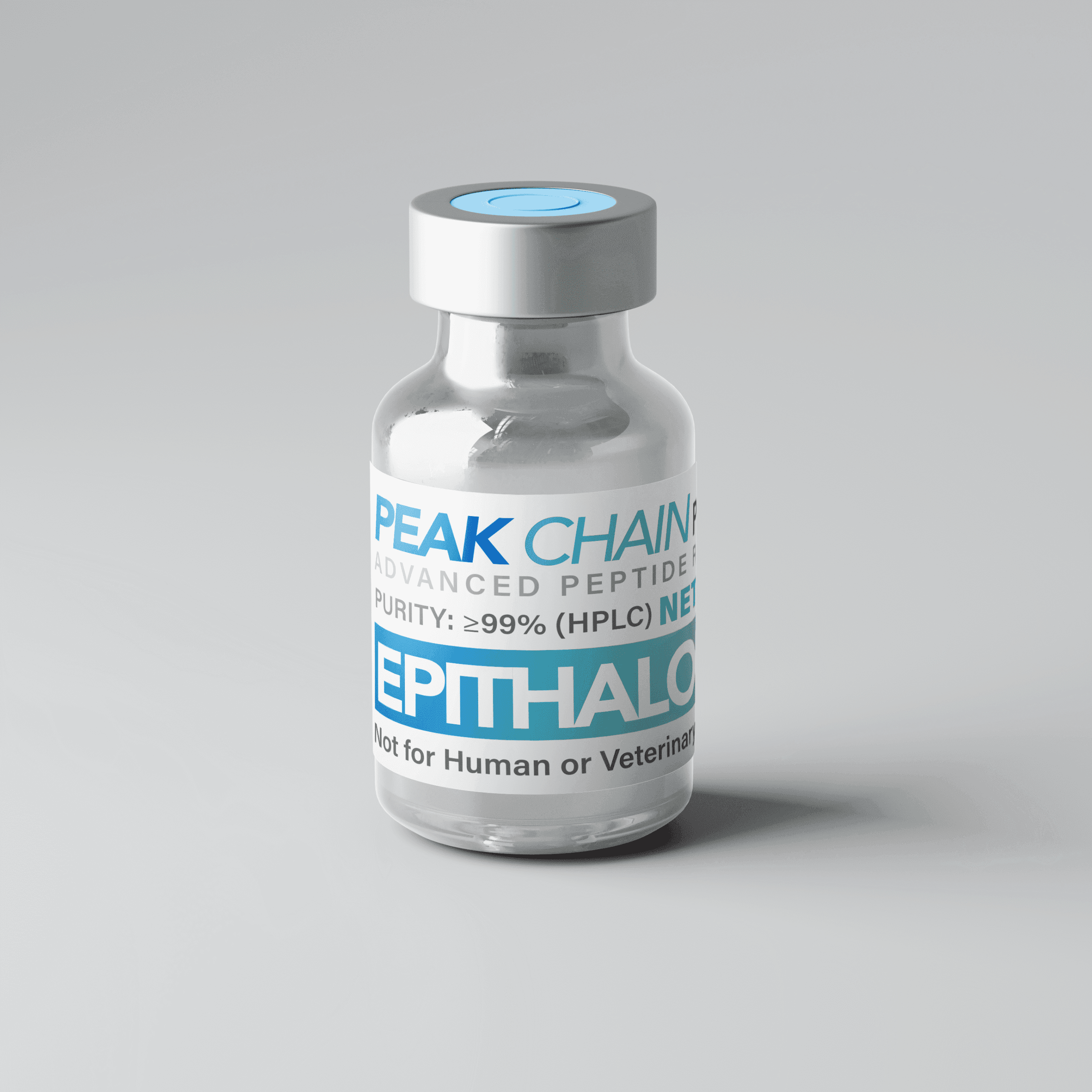
Epithalon
Selected option price: On sale. Original price $119.95. Sale price $59.98.
What Is Epithalon?
Epithalon (Epitalon®) is a synthetic tetrapeptide composed of:
Alanine – Glutamic Acid – Aspartic Acid – Glycine (Ala-Glu-Asp-Gly / AEDG).
It has been investigated in human cellular and clinical aging research for its reported influence on:
- Telomerase activation
- Telomere length regulation
- Replicative lifespan of human somatic cells
- Aging-associated biomarkers in elderly populations
Epithalon is not FDA-approved and is intended strictly for laboratory research use.
Telomeres: The Foundation of Epithalon Research
To understand Epithalon research, telomeres must be clearly defined.
What Are Telomeres?
Telomeres are repetitive DNA sequences located at the ends of chromosomes. They function as protective caps that:
- Prevent DNA fraying
- Prevent chromosomal fusion
- Maintain genomic stability during cell division
Each time a human somatic cell divides:
- Telomeres shorten slightly
- DNA damage signaling gradually increases
- Cells approach replicative senescence
When telomeres become critically short:
- Cells permanently stop dividing
- Tissue repair capacity declines
- Aging-associated dysfunction increases
The enzyme responsible for rebuilding telomeres is telomerase.
In most adult human somatic cells, telomerase activity is very low or absent.
Epithalon research investigates whether this peptide can influence telomerase expression and telomere length in human cells.
Human Cellular Research
1. Telomerase Activation & Telomere Elongation
A foundational human cell study examined Epitalon in telomerase-negative human fetal fibroblasts.
Reported findings:
- Activation of telomerase expression
- Detectable telomerase enzymatic activity
- Telomere elongation in treated cells
Human somatic cell study — telomerase activation & elongation:
https://pubmed.ncbi.nlm.nih.gov/12937682/
This study demonstrated measurable telomerase activation in human cells that normally lack telomerase activity.
Plain explanation: Cells that normally cannot rebuild their DNA ends showed telomerase activity after Epithalon exposure in a laboratory setting.
2. Extension of Replicative Lifespan (Human Fibroblasts)
Another human fibroblast study investigated whether Epitalon could influence the Hayflick limit — the natural cap on human cell division cycles.
Reported findings:
- Telomere length restoration toward early passage levels
- Increased number of cell divisions
- Delayed markers of cellular senescence
Human fibroblast study — extended lifespan & telomere restoration:
https://pubmed.ncbi.nlm.nih.gov/15455129/
Plain explanation: Human cells typically divide a limited number of times. In this study, treated cells divided longer under laboratory conditions.
Human Clinical Aging Research
3. 15-Year Follow-Up Study in Elderly Patients
A long-term clinical follow-up study evaluated peptide geroprotector programs including Epitalon in elderly populations over a 15-year period.
Reported findings included:
- Differences in long-term survival rates
- Modulation of aging-associated physiological markers
- Reported normalization of circadian-related endocrine parameters
15-year follow-up clinical study:
https://pubmed.ncbi.nlm.nih.gov/22451889/
This publication represents one of the longest indexed human follow-ups involving Epitalon-related aging programs.
Important note: This study was conducted within a specific geroprotector research framework and does not represent FDA-style therapeutic approval.
4. Human Aging & Peptide Bioregulator Programs (Neuroendocrine Focus)
A comprehensive clinical supplement published in Neuroendocrinology Letters reviewed long-term human studies involving peptide bioregulators, including Epitalon, in aging populations.
The supplement discusses:
- Endocrine aging patterns
- Chromosomal stability indicators
- Mortality trends in elderly cohorts
- Peptide-based geroprotection research models
Neuro Endocrinol Lett. 2002;23 Suppl 3:11-144
https://pubmed.ncbi.nlm.nih.gov/12374906/
This publication compiles human clinical data examining peptide-based aging interventions.
What the Human Evidence Suggests
Across published human cellular and clinical literature, Epithalon has been associated with:
- Activation of telomerase in human somatic cells
- Telomere elongation in vitro
- Extension of replicative lifespan in cultured human fibroblasts
- Observational associations with improved aging biomarkers in elderly cohorts
These findings are investigational and form part of ongoing telomere and longevity research.
Why Telomere Stability Matters in Longevity Science
Telomere shortening is recognized as one of the central biological hallmarks of aging.
Shortened telomeres are associated with:
- Cellular senescence
- Reduced regenerative capacity
- Genomic instability
- Increased age-related disease risk
Studying compounds that may influence telomerase activity allows researchers to explore:
- Mechanisms of cellular aging
- Genetic stability maintenance
- Biological aging modulation
In simplified terms:
Telomeres are the protective caps on DNA. Epithalon research explores whether those caps can be preserved longer in human cells under laboratory conditions.
Compliance Statement
Epithalon (Epitalon®) is a synthetic research peptide studied in human cellular and clinical literature for its relationship to telomerase activity and aging-associated biomarkers.
It is:
- Not approved by the U.S. Food and Drug Administration
- Not intended for human or veterinary use
- For laboratory research purposes only
No additional information available.
Certificate of Analysis — 50 mg
Independent third-party analytical testing is performed on every production batch. The document to the left contains all testing results for the batch corresponding to this product.
Opens / saves as PDF document