
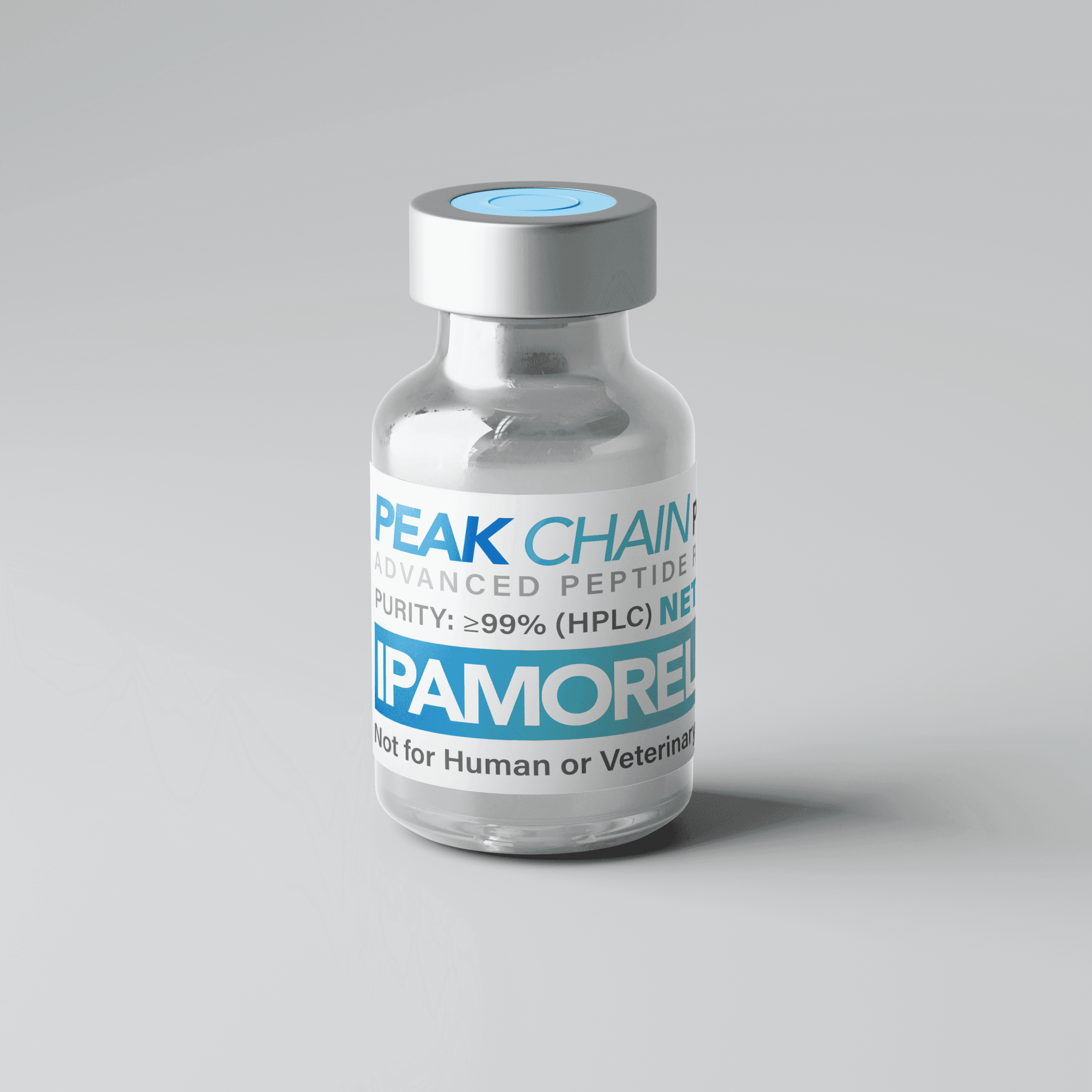
Ipamorelin
SKU: IP10-PC
What Is Ipamorelin?
Ipamorelin is a synthetic pentapeptide developed as a growth hormone (GH) secretagogue — a compound designed to stimulate the body’s own natural, pulsatile release of growth hormone. In research discussions, ipamorelin is typically framed as a “signal-based” compound: rather than supplying growth hormone directly, it is studied for how it can prompt the body to produce a brief, measurable GH pulse that resembles natural rhythm-style secretion.
A key reason ipamorelin is often described as “rhythm-friendly” in research terms is its short pharmacokinetic presence and its ability to produce a single, time-limited GH episode in controlled human study designs—useful for endocrine timing research and pulse mapping.
Human PK/PD modeling describing a single GH episode and time-to-peak (~0.67 hr):
https://pubmed.ncbi.nlm.nih.gov/10496658/
Regulatory Status
Ipamorelin is not FDA-approved as a drug product. It is generally supplied in the marketplace as research material, and any educational content should remain within a research-only scope (no dosing, no administration instructions, no disease claims).
FDA guidance addressing unapproved peptide products / related regulatory context:
https://www.fda.gov/media/182088/download
Mechanism of Action
Primary Target: Ghrelin Pathway (GHS-R1a)
The receptor system that ipamorelin is designed to engage is the same biological pathway identified with the discovery of ghrelin—a stomach-derived, growth-hormone–releasing peptide. This landmark work established the physiologic foundation for ghrelin-mimetic signaling and the broader “growth hormone secretagogue receptor” concept that later compounds were built around.
Landmark ghrelin discovery paper (Nature, 1999):
https://pubmed.ncbi.nlm.nih.gov/10604470/
In practical research terms, this mechanism framing helps explain why ipamorelin is discussed as a compound used to explore endocrine signaling timing, rather than as something that produces prolonged hormone elevation.
Selectivity Profile
In the early literature, ipamorelin is positioned as notably selective for GH release relative to some earlier GH-releasing peptides—particularly in terms of showing less stimulation of ACTH/cortisol pathways in comparative profiling. This selectivity theme is central to how ipamorelin is described scientifically and is often used to explain why researchers may choose it when they want a GH-focused signal without broad activation of other pituitary/adrenal outputs.
European Journal of Endocrinology paper describing ipamorelin as a selective GH secretagogue:
https://pubmed.ncbi.nlm.nih.gov/9849822/
Downstream Endocrine Response
Because GH is released in pulses, a lot of ipamorelin research interest centers on kinetics and timing — not just “does GH rise,” but how quickly it rises, how sharply it peaks, and how efficiently it returns toward baseline. Researchers often track:
- Time-to-peak GH
- Pulse shape and duration
- Return-to-baseline timing
- Dose–exposure relationships tied to pulse dynamics
The core human PK/PD study describing ipamorelin’s short half-life (~2 hours) and a single GH episode with peak at ~0.67 hours:
https://pubmed.ncbi.nlm.nih.gov/10496658/
(Note: This section intentionally stays focused on timing/shape of GH response, because those are the specific outcomes supported by the linked PK/PD publication.)
Published Human & Clinical Research
Healthy Volunteer PK/PD Characterization
In controlled healthy-volunteer research, ipamorelin has been characterized as producing a brief systemic presence and a single episodic GH response — a profile that supports research designs where the goal is to evaluate hormone signaling patterns without prolonged stimulation. The published model-based findings provide a foundation for understanding:
- Short terminal half-life (~2 hours)
- Peak GH response under an hour (reported model estimate ~0.67 hours)
- Exponential decline back toward negligible GH response after the pulse
(Referenced above in the downstream response section to avoid duplication; not repeated here.)
Post-operative Ileus (GI Recovery) — Phase 2 Clinical Work
Ipamorelin was evaluated as a ghrelin-mimetic agent in a proof-of-concept Phase 2 postoperative ileus setting (bowel resection context). The published clinical report describes it as generally well tolerated, but it did not demonstrate statistically significant improvement versus placebo on key endpoints in that specific clinical context, and development for that indication was not continued.
Randomized proof-of-concept Phase 2 study (postoperative ileus):
https://pubmed.ncbi.nlm.nih.gov/25331030/
ClinicalTrials.gov registry entry for the study context and outcomes framework:
https://clinicaltrials.gov/study/NCT01280344
Laboratory Detection & Analytical Validation
A separate body of peer-reviewed work discusses ipamorelin from an analytical science perspective—focused on laboratory detection, identification, and metabolite profiling of growth hormone releasing peptides (GHRPs).
Mass spectrometry and metabolism profiling (Analytical chemistry)
Analytical Chemistry work on the metabolism of growth hormone releasing peptides explicitly identifies ipamorelin among the key compounds of interest and discusses laboratory approaches used to study these peptides and their metabolic profiles—supporting research and regulated testing methodologies that require confident identification.
Anal Chem. 2012 — metabolism of growth hormone releasing peptides (includes ipamorelin):
https://pubmed.ncbi.nlm.nih.gov/23101768/
LC–MS/MS detection and metabolite characterization (Drug testing context)
Drug Testing and Analysis work investigated urinary metabolites of several GHRPs and explicitly includes ipamorelin in its scope, supporting how labs validate detection/identification workflows when peptide confirmation is required.
Drug Test Anal. 2015 — urinary metabolites / detection approach (includes ipamorelin):
https://pubmed.ncbi.nlm.nih.gov/25869809/
(These analytical references are compliance-friendly because they speak to laboratory identification and validation—not health outcomes.)
Simply Put (Plain-English Explanation)
Growth hormone is best thought of as a signal the body releases in bursts, not as a constant “on” switch. Ipamorelin is a lab-made peptide designed to tap into the same biological pathway that became widely understood after the discovery of ghrelin — a natural hormone that can trigger growth hormone release.
Ghrelin discovery (establishes the natural pathway):
https://pubmed.ncbi.nlm.nih.gov/10604470/
In human research, ipamorelin showed a short presence in the body and produced one clear GH pulse with a measured time-to-peak under an hour. That makes it useful for research looking at hormone timing and pulse behavior, because the signal is brief and easier to map cleanly.
Human PK/PD timing and pulse data:
https://pubmed.ncbi.nlm.nih.gov/10496658/
It has also been tested clinically in post-surgical digestive recovery settings, where it did not show a meaningful advantage over placebo on the primary outcomes measured in that context.
Phase 2 postoperative ileus clinical study:
https://pubmed.ncbi.nlm.nih.gov/25331030/
Additional Scientific Research Information
Raun K, Hansen BS, Johansen NL, et al. “Ipamorelin, the first selective growth hormone secretagogue.” European Journal of Endocrinology, 1998. PubMed:
https://pubmed.ncbi.nlm.nih.gov/9849822/
DOI: https://doi.org/10.1530/eje.0.1390552
Gobburu JV, Agerso H, Jusko WJ, Ynddal L. “Pharmacokinetic-pharmacodynamic modeling of ipamorelin, a growth hormone releasing peptide, in human volunteers.” Pharmaceutical Research, 1999. PubMed:
https://pubmed.ncbi.nlm.nih.gov/10496658/
Beck DE, Sweeney WB, McCarter MD; Ipamorelin 201 Study Group. “Prospective, randomized, controlled, proof-of-concept study of the ghrelin mimetic ipamorelin for the management of postoperative ileus in bowel resection patients.” International Journal of Colorectal Disease, 2014. PubMed:
https://pubmed.ncbi.nlm.nih.gov/25331030/
DOI: https://doi.org/10.1007/s00384-014-2030-8
Ishida J, Saitoh M, Ebner N, et al. “Growth hormone secretagogues: history, mechanism of action, and clinical development.” JCSM Rapid Communications, 2020. DOI/journal page:
https://doi.org/10.1002/rco2.9
Hansen BS, Raun K, Nielsen KK, et al. “Pharmacological characterisation of a new oral GH secretagogue, NN703.” European Journal of Endocrinology, 1999. PubMed:
https://pubmed.ncbi.nlm.nih.gov/10427162/
ClinicalTrials.gov — Safety and Efficacy of Ipamorelin Compared to Placebo for the Recovery of Gastrointestinal Function (NCT01280344).
https://clinicaltrials.gov/study/NCT01280344
ClinicalTrials.gov — Safety and Efficacy of Ipamorelin for Management of Post-Operative Ileus (NCT00672074). This trial ID is referenced by the 2014 bowel resection study. PubMed article:
https://pubmed.ncbi.nlm.nih.gov/25331030/
FDA / compounding review materials — Ipamorelin acetate. Summary report archive PDF:
https://archive.hshsl.umaryland.edu/bitstreams/a5418602-1aaf-4c10-a573-e5756259c751/download
FDA advisory materials page referencing ipamorelin acetate:
Buscail E, Deraison C. “Postoperative ileus: A pharmacological perspective.” British Journal of Pharmacology, 2022. DOI/journal page:
https://doi.org/10.1111/bph.15800
Compliance & Safety Positioning
- Not FDA approved
- Not intended to diagnose, treat, cure, or prevent any disease
- Not for human or veterinary use
- Supplied strictly for laboratory research
FDA regulatory context reference
| SKU | IP10-PC |
|---|